critics
Explanation
The Joke
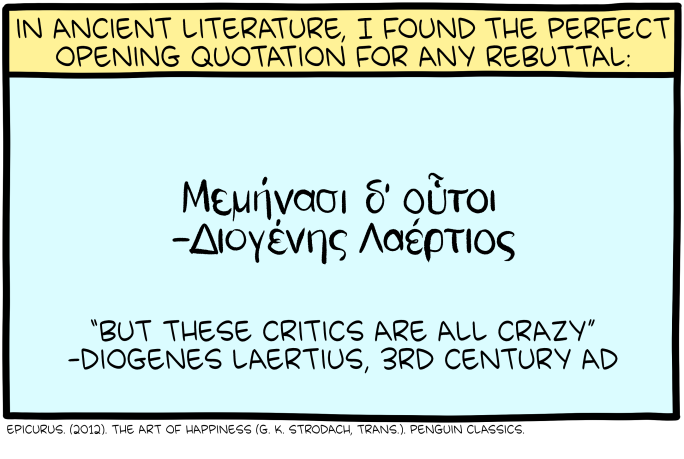
The comic presents a single panel formatted like an academic slide or note card. The header reads: "In ancient literature, I found the perfect opening quotation for any rebuttal." Below is a quote in the original Greek, attributed to Diogenes Laertius (3rd century AD), followed by its English translation: "But these critics are all crazy." A citation at the bottom references Epicurus (2012), "The Art of Happiness" (G. K. Strodach, Trans.), Penguin Classics.
The Humor
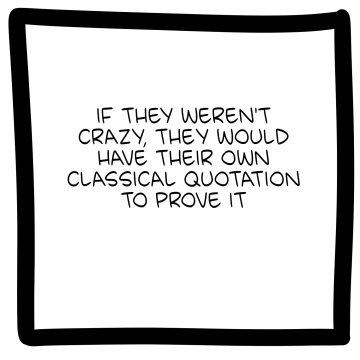
The joke is that after millennia of philosophical discourse and literary tradition, the single most useful quotation one could find for responding to critics is essentially "they're all nuts." The humor comes from the contrast between the scholarly apparatus — an ancient Greek quote, a proper academic citation, a serious classical source — and the utterly dismissive, anti-intellectual content of the quote itself. It's a joke about how the most sophisticated-looking rebuttal is actually just a fancy way of saying "ignore the haters." There's also a meta-humor element: by presenting this as a universally applicable opening for "any rebuttal," the comic suggests that all intellectual debate can be reduced to ad hominem dismissal, as long as you dress it up with enough classical gravitas.
Context
Diogenes Laertius was a 3rd-century biographer of Greek philosophers, best known for "Lives and Opinions of Eminent Philosophers." The quote comes from his writings on Epicurus. The formal academic citation style (APA format) adds to the comedic contrast between scholarly presentation and the blunt content of the quote. SMBC frequently mines humor from philosophy and academic culture.