Culture
Explanation
The Joke
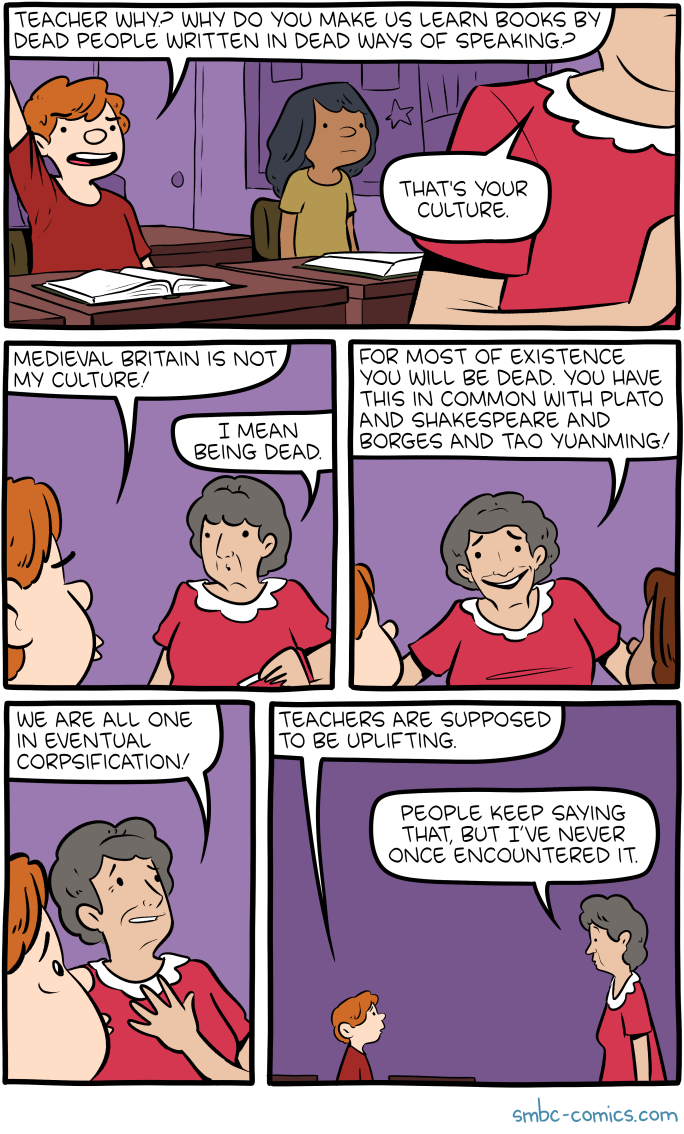
A student asks her teacher a pointed question: "Teacher, why do you make us learn books by dead people written in dead ways of speaking?" The teacher responds, "That's your opinion." The student pushes back: "Modern writing is not my opinion. I mean, using books..." The teacher then provides the standard justification: "For most of existence, you will be dead. You have to read Homer and Shakespeare and Borges and Tao, and..." But the student's retort cuts right through: "We are all one elemental composition."
The student objects that teachers are supposed to be uplifting, but the teacher's defense is that "people keep saying that but I've never once encountered it." The comic satirizes the common classroom debate about why students must read classic literature, with the teacher's defense being an unexpectedly nihilistic appeal to mortality -- you'll be dead most of the time, so you might as well commune with other dead people's writing.
The Humor
The comedy works through escalation and subversion. The student raises a legitimate and relatable complaint about being forced to read old literature, and instead of getting an inspiring answer about the beauty of the canon or the universality of great literature, she gets a darkly existential argument: since you'll be dead for most of eternity, you should get used to engaging with dead people's work. The teacher's final admission that she has never actually encountered the idea that teachers should be uplifting is the punchline -- a deadpan confession that demolishes any pretense of pedagogical idealism.
References
The comic references major literary figures -- Homer (ancient Greek epic poet), Shakespeare (English playwright), Borges (Argentine author known for metaphysical fiction), and Tao (likely referring to a philosophical or literary tradition). These represent the "dead people's books" that form the traditional literary canon students are often required to study.