cylinder
Explanation
The Joke
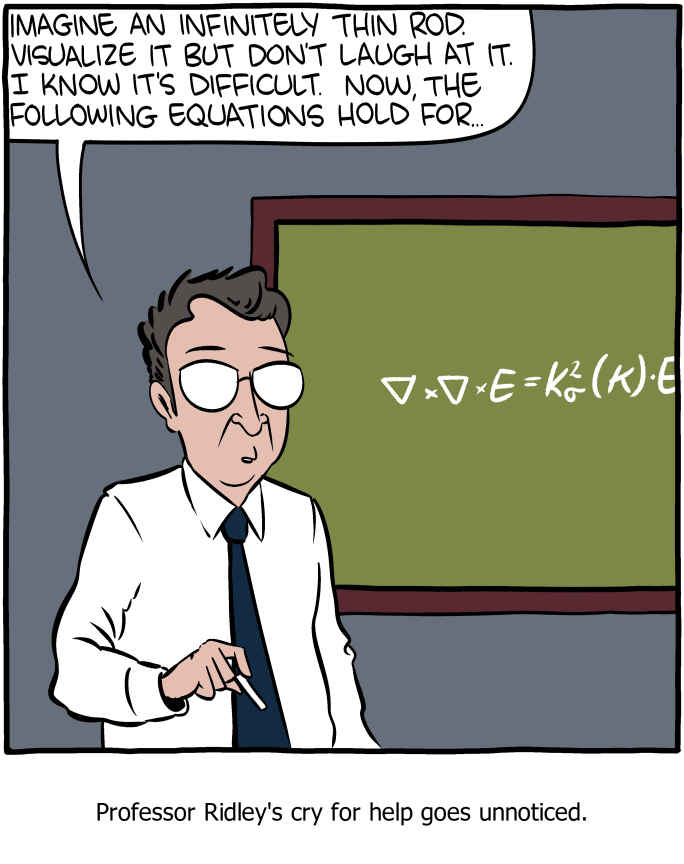
A physics professor is lecturing about cylindrical coordinates or electromagnetic theory, asking his students to "imagine an infinitely thin rod" -- a standard setup in physics problems. He then immediately adds "Visualize it but don't laugh at it. I know it's difficult." The equation on the board (involving the divergence of the electric field) confirms this is a legitimate physics lecture. The caption reads "Professor Ridley's cry for help goes unnoticed."
The comic operates on two levels. On the surface, the professor is acknowledging the innuendo inherent in asking a room full of students to picture a long, thin rod -- a real challenge physics instructors face. But the caption reframes the whole scene: what seemed like a self-aware joke about phallic imagery is actually the professor desperately signaling that he is unhappy, possibly burned out or in crisis. His students, however, interpret his aside as just another quirky professorial comment and ignore it entirely.
The Humor
The humor comes from the collision between the dry, serious world of physics education and crude anatomical humor, combined with a darker undercurrent. The professor's plea is both a comedic acknowledgment of the double entendre and a genuine expression of distress that nobody recognizes. SMBC frequently mines the gap between what academics say in formal settings and the absurd or tragic subtext lurking beneath the surface. The caption delivers the punchline by suddenly recasting the entire scene in a sadder light, a classic Weinersmith move of mixing lowbrow humor with existential despair.
References
- The equation on the board resembles the Helmholtz equation or a vector wave equation, standard fare in electromagnetism courses.
- "Infinitely thin rod" is a common idealization in physics for calculating electric fields, gravitational fields, or moments of inertia.