dance-3
Explanation
This comic imagines a world where all mathematical and scientific jargon is replaced with dance terminology, and finds that it is unexpectedly delightful.
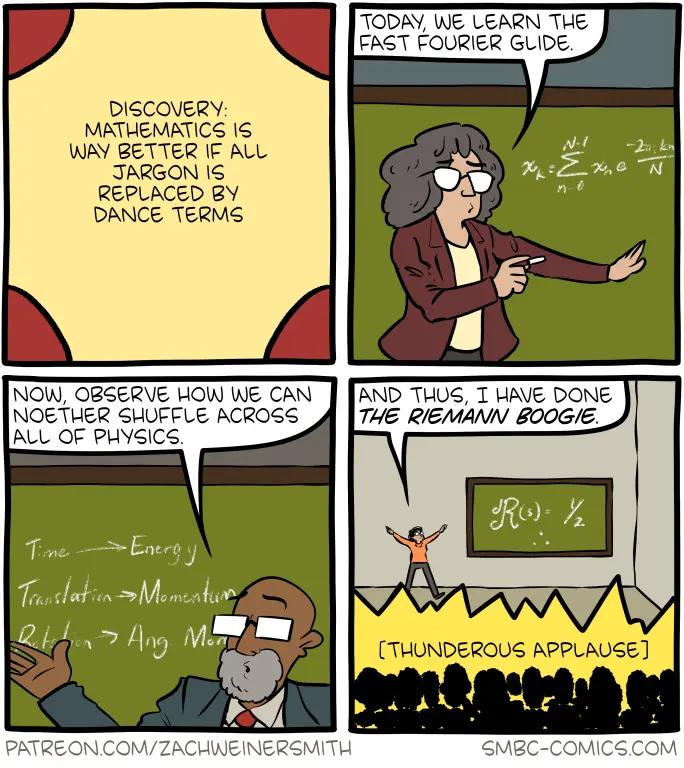
The first panel announces the premise: "Discovery: Mathematics is way better if all jargon is replaced by dance terms." The subsequent panels demonstrate this by renaming real mathematical and physical concepts as dances. "The Fast Fourier Transform" (a fundamental algorithm in signal processing and computational mathematics) becomes "The Fast Fourier Glide." "Noether's Theorem" (Emmy Noether's profound theorem connecting symmetries to conservation laws in physics, e.g., time symmetry implies conservation of energy, translational symmetry implies conservation of momentum) becomes the "Noether Shuffle." The climax shows a mathematician triumphantly announcing that he has completed "The Riemann Boogie" -- a reference to the Riemann Hypothesis (one of the most famous unsolved problems in mathematics, concerning the distribution of prime numbers and the zeros of the Riemann zeta function where the real part equals 1/2). The audience erupts in thunderous applause.
The humor works through the incongruity of pairing serious, abstract mathematical concepts with playful dance names. There is something inherently funny about imagining a staid mathematics lecture delivered with the energy of a dance performance. But the joke also has a deeper layer: mathematics really does involve elegant, choreographed manipulations of symbols, and theorems really do have a kind of beauty and rhythm to them. By renaming them as dances, Weinersmith highlights the aesthetic dimension of mathematics that practitioners genuinely feel but struggle to communicate to outsiders. The final panel, where solving the Riemann Hypothesis is treated like landing a spectacular dance move to a roaring crowd, captures the fantasy of every mathematician -- that the public would react to a great proof with the same enthusiasm they show for entertainment.