dark-matter

Explanation
The Joke
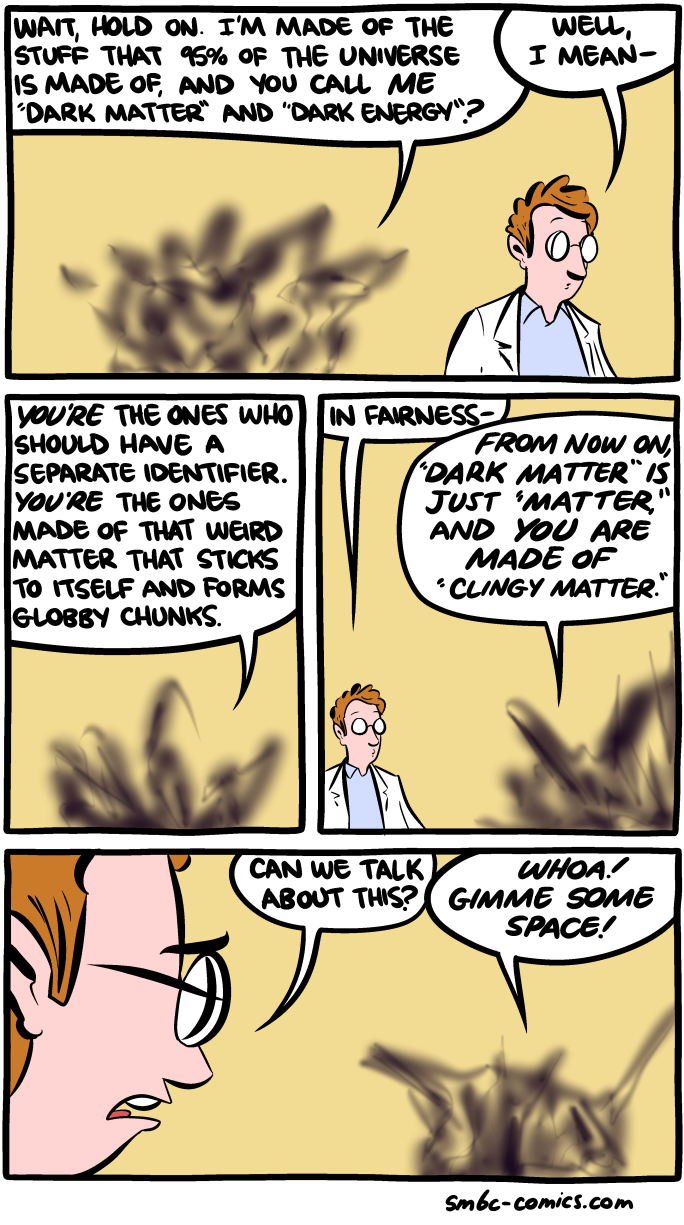
A scientist confronts the naming conventions in physics: ordinary matter, which makes up everything we can see and interact with, is only about 5% of the universe, yet the other 95% (dark matter and dark energy) is named as though it is the aberration. The scientist argues that since dark matter and dark energy make up the vast majority of the universe, they should have the normal-sounding name, while regular matter -- the weird minority -- should have the special identifier. He proposes that "dark matter" should be renamed to just "matter," while what we currently call "matter" should be called "clumpy matter" since it is the odd stuff that sticks to itself and forms globby chunks. Another character asks, "Can we talk about this?" and the scientist replies, "Ugh, gimme some space!"
The Humor
The joke hinges on a legitimate quirk of scientific nomenclature. Dark matter and dark energy together constitute roughly 95% of the mass-energy content of the universe, yet they are defined relative to ordinary matter as the "dark" (i.e., mysterious, unknown) version. The scientist's logic is sound in a pedantic way: the majority should get the default name, and the minority should get the qualifier. The proposed rename of ordinary matter to "clumpy matter" is both technically accurate (ordinary matter does clump into structures like stars, planets, and people) and hilariously undignified. The final pun -- "gimme some space" -- works both as an annoyed dismissal and as a physics joke, since space itself is mostly made of the dark stuff.
References
The comic references the cosmological discovery that ordinary (baryonic) matter makes up only about 5% of the total mass-energy of the observable universe, with dark matter comprising about 27% and dark energy about 68%, according to observations from the Planck satellite and other cosmological surveys.