Dear Satan
Explanation
The Joke
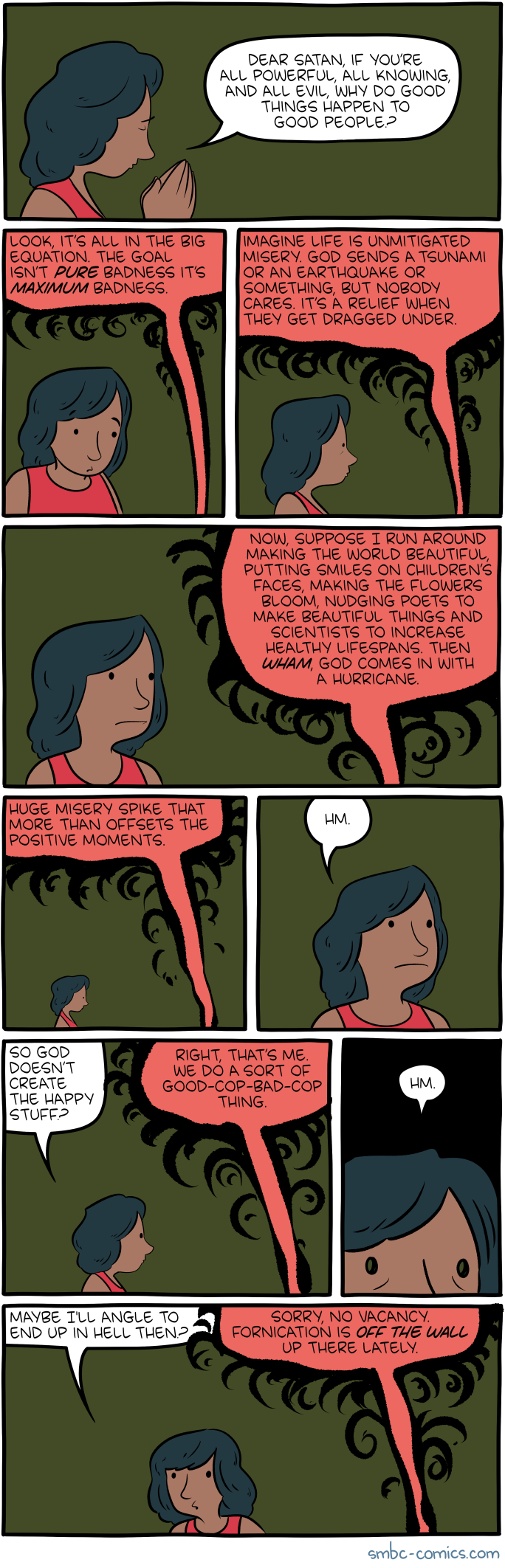
A woman writes "Dear Satan" (not Santa) asking: if Satan is all-powerful, all-knowing, and all-evil, why do good things happen to good people? This is an inversion of the classic theological Problem of Evil ("why do bad things happen to good people if God is good?"), reframed as the "Problem of Good" directed at Satan.
Satan offers several explanations that mirror real theodicy arguments: maybe Satan tried to stop good things but couldn't prevent "earthquakes of happiness," or perhaps it's a "belief tester" (paralleling the idea that God allows suffering to test faith). Satan suggests that pure evil is complicated — "making the good beautiful, putting rainbows on oil slicks" — and that causing evil sometimes accidentally creates good as a side effect, like a scientist trying to increase carbon emissions who accidentally discovers something beautiful. Satan then asks "Would you rather have the happy good-cop-bad-cop thing?"
The woman concludes "Maybe I'll write to God" and Satan nervously responds "Could you put in a good word? We haven't really been talking much up there lately."
The Humor
The comic is a clever philosophical inversion. By applying the Problem of Evil to Satan instead of God, it reveals how theodicy arguments sound when flipped — they're equally unconvincing in either direction. Every excuse theologians make for God permitting evil works just as well for Satan accidentally permitting good. The final panel adds a humanizing twist: Satan and God apparently have a strained relationship, reducing cosmic theological debates to the level of interpersonal drama. The comic satirizes theodicy by showing that the logical structure of the arguments is symmetrical and therefore somewhat hollow.