death-4

Explanation
The Joke
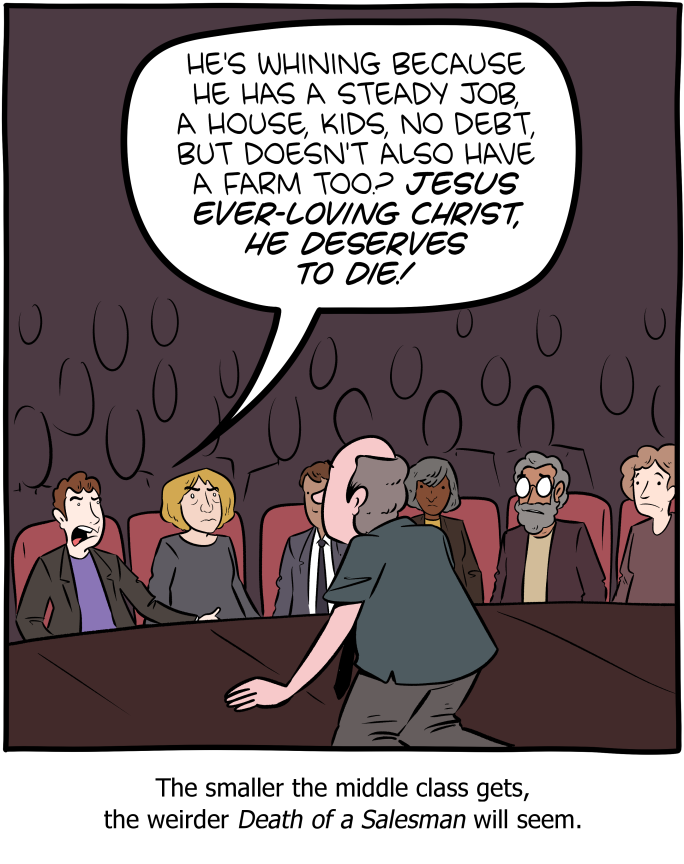
The comic shows a theater audience watching a performance. An audience member is commenting on the character in the play: "He's whining because he has a steady job, a house, kids, no debt, but doesn't also have a farm too -- Jesus ever-loving Christ, he deserves to die!" The caption below reads: "The smaller the middle class gets, the weirder Death of a Salesman will seem."
The joke is about how Arthur Miller's classic 1949 play "Death of a Salesman" portrays protagonist Willy Loman as a tragic figure who is dissatisfied with his middle-class life. In 1949, audiences could empathize with his existential dissatisfaction because many of them shared similar comfortable-but-unfulfilling circumstances. But as the middle class shrinks and economic security becomes harder to achieve, future audiences will find Willy Loman's complaints increasingly alien and unsympathetic -- the man has a house, a job, and kids, and he's complaining?
The Humor
The humor is rooted in a sharp socioeconomic observation. The comic extrapolates a real cultural trend -- the shrinking of the American middle class -- to its logical comedic conclusion: classic literature about middle-class malaise will eventually become incomprehensible to audiences who would consider Willy Loman's situation aspirational rather than tragic. The audience member's outraged reaction ("he deserves to die!") is funny because it reframes the tragedy as tone-deaf privilege, which is exactly how economic shifts can alter the reception of art over time.
References
"Death of a Salesman" (1949) by Arthur Miller is one of the most celebrated American plays. It follows Willy Loman, an aging traveling salesman who struggles with disillusionment about the American Dream despite having achieved a modest middle-class life. The play won the Pulitzer Prize for Drama and the Tony Award for Best Play.