death-of-an-economist

Explanation
The Joke
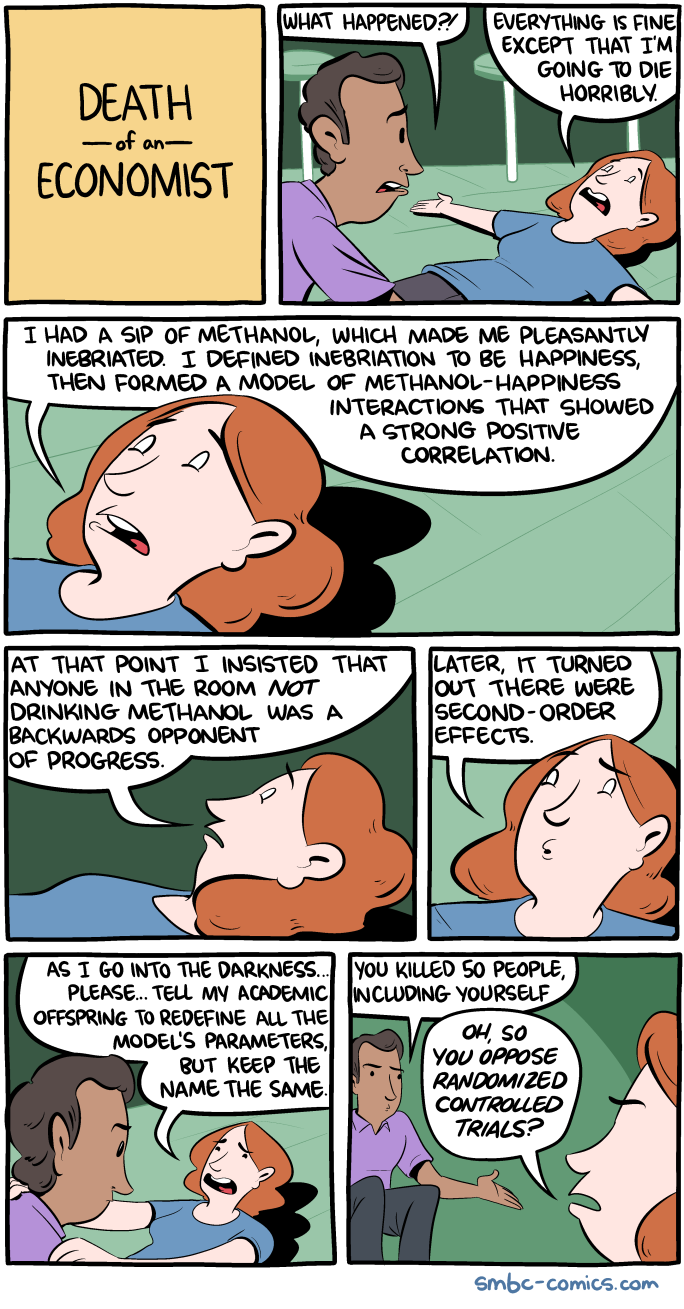
The comic is titled "Death of an Economist." A man lies dying and recounts his final moments in economic jargon: he had a sip of methanol which made him pleasantly inebriated, so he displayed a revealed preference for happiness, then formed a model of methanol-happiness interactions that showed a strong positive correlation. He then insisted that anyone in the room not drinking methanol was behaving irrationally. It then turned out there were second-order effects (i.e., methanol is lethal poison). As he dies, he asks the onlookers not to call the coroner a "coroner" but to refer to the position as "applied necroeconomist" -- and reminds them that the coroner'''s parametric assumptions require that all corpses have the same name.
The Humor
The comic satirizes the tendency of economists to apply economic frameworks and jargon to everything, even when those frameworks are wildly inappropriate. The dying economist'''s fatal error is a perfect metaphor for the discipline'''s blind spots: he observed a positive correlation (methanol makes me feel good), declared everyone not following his model irrational, and ignored the "second-order effects" (it kills you). This mirrors real criticisms of economics: overreliance on simple models, dismissal of anyone who disagrees as "irrational," failure to account for complex downstream effects, and insistence on renaming common concepts with specialized jargon ("applied necroeconomist" for coroner). The final joke about parametric assumptions requiring all corpses to have the same name lampoons the discipline'''s tendency to make absurd simplifying assumptions to make models tractable.
References
"Revealed preference" is a concept in microeconomics introduced by Paul Samuelson, which infers consumer preferences from observed purchasing behavior. Second-order effects refer to indirect or downstream consequences that are not captured by first-order (immediate) analysis. Methanol (wood alcohol) is indeed toxic to humans and can cause blindness and death, unlike ethanol (drinking alcohol). Parametric assumptions refer to statistical assumptions about the distribution or properties of data that underlie many economic models.