dilemma
Explanation
The Joke
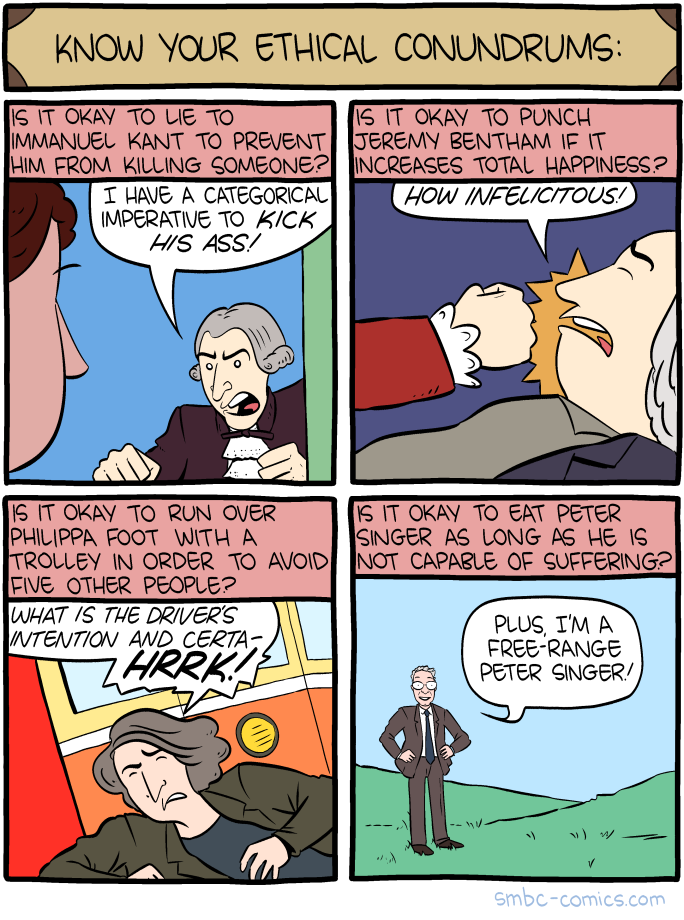
The comic is titled "Know Your Ethical Conundrums" and presents a series of four panels, each posing an absurd ethical dilemma involving a famous philosopher or ethicist. Each scenario twists the philosopher's own ethical framework against them in a ridiculous way.
The first panel asks whether it is okay to lie to Immanuel Kant to prevent a murder -- a reference to Kant's famous absolutist position that lying is always morally wrong, even to a murderer at the door. The second asks if it is okay to punch Jeremy Bentham if it increases net happiness, turning Bentham's own utilitarian calculus against him. The third panel presents another utilitarian scenario involving running someone over. The fourth asks if it is okay to eat Peter Singer as long as he is free-range -- and Singer cheerfully confirms he is indeed free-range. This is a delicious twist on Singer's own arguments about animal welfare, which focus on the conditions of animal treatment rather than absolute prohibitions on eating them.
The Humor
The comedy comes from taking each philosopher's ethical framework and applying it to the philosopher themselves in the most absurd and literal way possible. Kant, who argued you must never lie, is placed in a scenario where lying would prevent murder. Bentham, who said we should maximize happiness, faces being punched if it makes everyone else happy. And Singer, who argues that the ethical treatment of animals matters more than whether we eat them, logically cannot object to being eaten as long as he was humanely raised. Each scenario is a reductio ad absurdum of the philosopher's own position, and the philosophers are trapped by their own logic. The format parodies educational infographics or "Know Your..." guides, adding a layer of fake-authoritative humor.
References
- Immanuel Kant (1724-1804): German philosopher who argued that lying is always morally impermissible under his categorical imperative, regardless of consequences.
- Jeremy Bentham (1748-1832): English philosopher and founder of utilitarianism, which holds that the right action is the one that produces the greatest happiness for the greatest number.
- Peter Singer (b. 1946): Australian moral philosopher known for his work on animal liberation and ethics. Singer argues against factory farming and for the ethical treatment of animals, focusing on suffering rather than on an absolute prohibition against using animals. The "free-range" joke plays on his position that the conditions under which animals are raised matter morally.