Dilemma
Explanation
The Joke
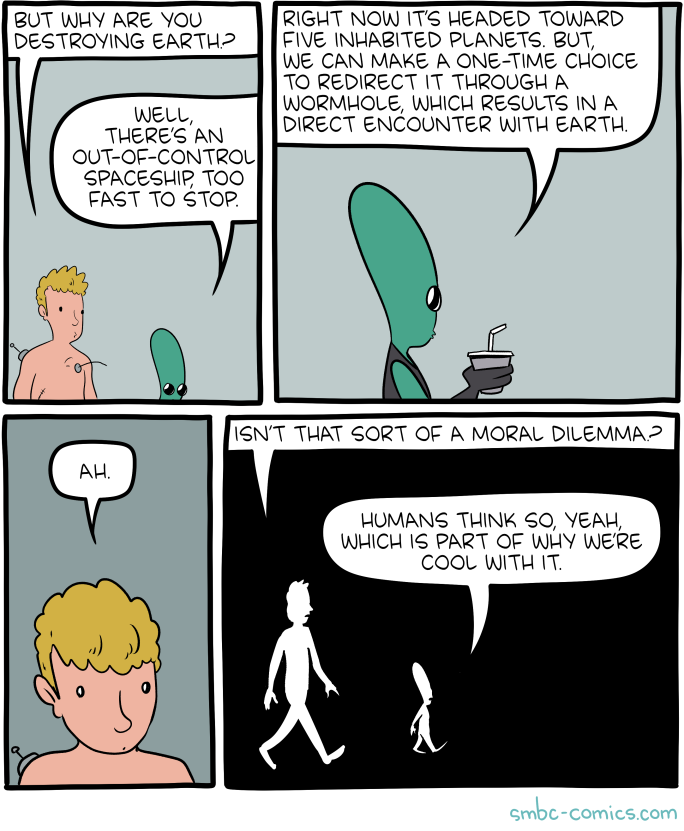
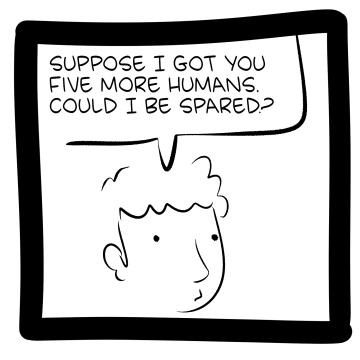
In this comic, tagged "Aliens," an extraterrestrial being presents a moral dilemma to a human. The alien announces that right before the human dies, they are also going to steal from the human to feed the hungry. This creates a layered ethical puzzle — the human is about to die anyway, and the theft would go to a noble cause (feeding the hungry), so there is essentially no rational reason to object. Yet the framing as "stealing" still triggers an instinctive moral objection.
The comic is a riff on classic ethical dilemmas and trolley-problem-style thought experiments, where the "correct" moral answer conflicts with gut emotional reactions. The alien framing is typical of SMBC — by having an outside observer (an alien) present these dilemmas, Weinersmith highlights how human moral intuitions are often inconsistent and driven more by framing than by actual outcomes. If the alien had said "we'll donate your possessions to charity after you die," it would sound noble, but calling it "stealing" makes the same action sound sinister.
The Humor
The humor comes from the absurdity of the dilemma itself. The alien is essentially asking permission to do something that is both inconsequential to the victim (who is about to die) and morally good (feeding the hungry), but framing it in a way designed to make the human uncomfortable. It is funny because it exposes how much our moral reasoning depends on word choice and framing rather than actual consequences.
The alien delivery adds an extra comedic layer — the clinical, matter-of-fact way aliens in SMBC comics tend to describe human situations strips away the usual emotional context and forces the reader to confront the raw logic of the scenario.
References
- Trolley problem and moral dilemmas: The comic references the philosophical tradition of thought experiments designed to test moral intuitions, particularly the tension between consequentialist ethics (outcomes matter most) and deontological ethics (certain actions are inherently wrong regardless of outcomes).
- The framing effect: A well-documented cognitive bias where people's decisions are influenced by how information is presented rather than by the information itself — a key concept in behavioral economics and psychology.