Dissimulation
Explanation
The Joke
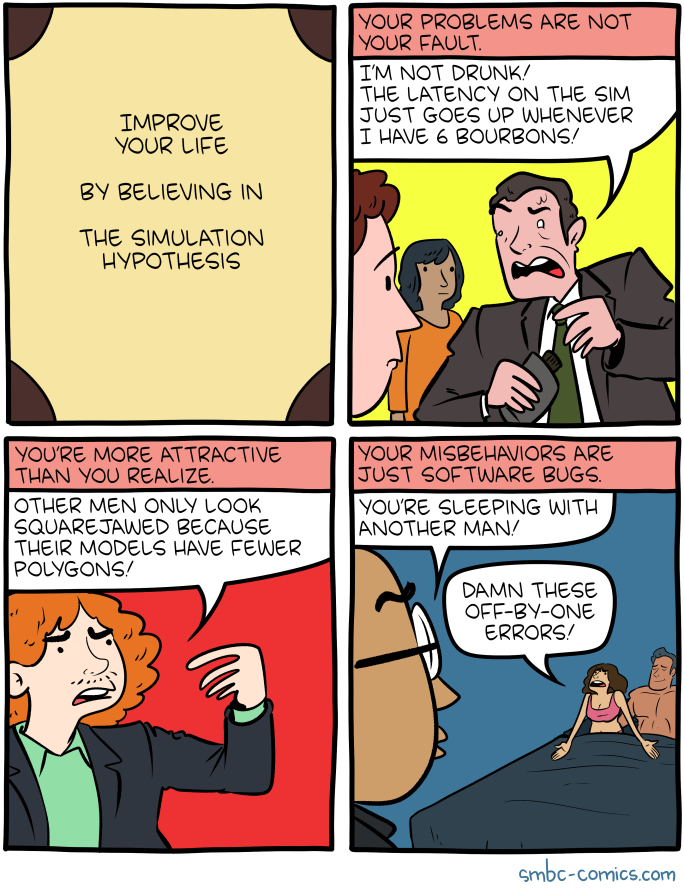
The comic presents a self-help pitch: "Improve your life by believing in the Simulation Hypothesis." The idea is framed as a motivational technique. A man in a suit explains the supposed benefits: "Your problems are not your fault!" and "I'm not drunk, the latency on the GM for my avatar is bad. I have a bourbon." He is reframing his personal failures as glitches in a computer simulation rather than taking responsibility for them.
The next panels escalate: "You're more attractive than you realize" is explained with "Your polygon count is limited. You're actually way hotter in the source code." The final panel delivers the punchline: "Your flaws aren't software bugs, they're features" or similar -- the man has completely reinterpreted the Simulation Hypothesis not as a philosophical position but as a coping mechanism for personal inadequacy. "Damn those polygons!" someone exclaims, blaming the simulation's rendering for their appearance rather than accepting reality.
The Humor
The comic takes the Simulation Hypothesis -- a legitimate philosophical and scientific proposition that our reality might be a computer simulation -- and reduces it to a self-help gimmick. Instead of grappling with the profound existential implications of possibly living in a simulation, the characters use it as an excuse for everything wrong in their lives. Drunk? It is lag. Unattractive? Low polygon count. The humor lies in the gap between the cosmic profundity of the hypothesis and the petty, mundane uses people put it to.
This is a classic SMBC move: taking a genuine intellectual concept and showing how humans would inevitably debase it for personal convenience. The comic also parodies the self-help industry's tendency to repackage complex ideas into simple, flattering narratives that absolve people of responsibility.
References
The Simulation Hypothesis, most famously articulated by philosopher Nick Bostrom in his 2003 paper "Are You Living in a Computer Simulation?", proposes that advanced civilizations might run detailed simulations of their ancestors, meaning we could be living in such a simulation. The comic references gaming terminology -- polygon counts, lag, source code, avatars -- drawing parallels between the simulation hypothesis and video game rendering. The term "dissimulation" in the title is a pun combining "simulation" with "dissimulation" (the act of concealing one's true nature), suggesting the hypothesis is being used to hide from personal truths.