do-humans-have-feelings
Explanation
The Joke
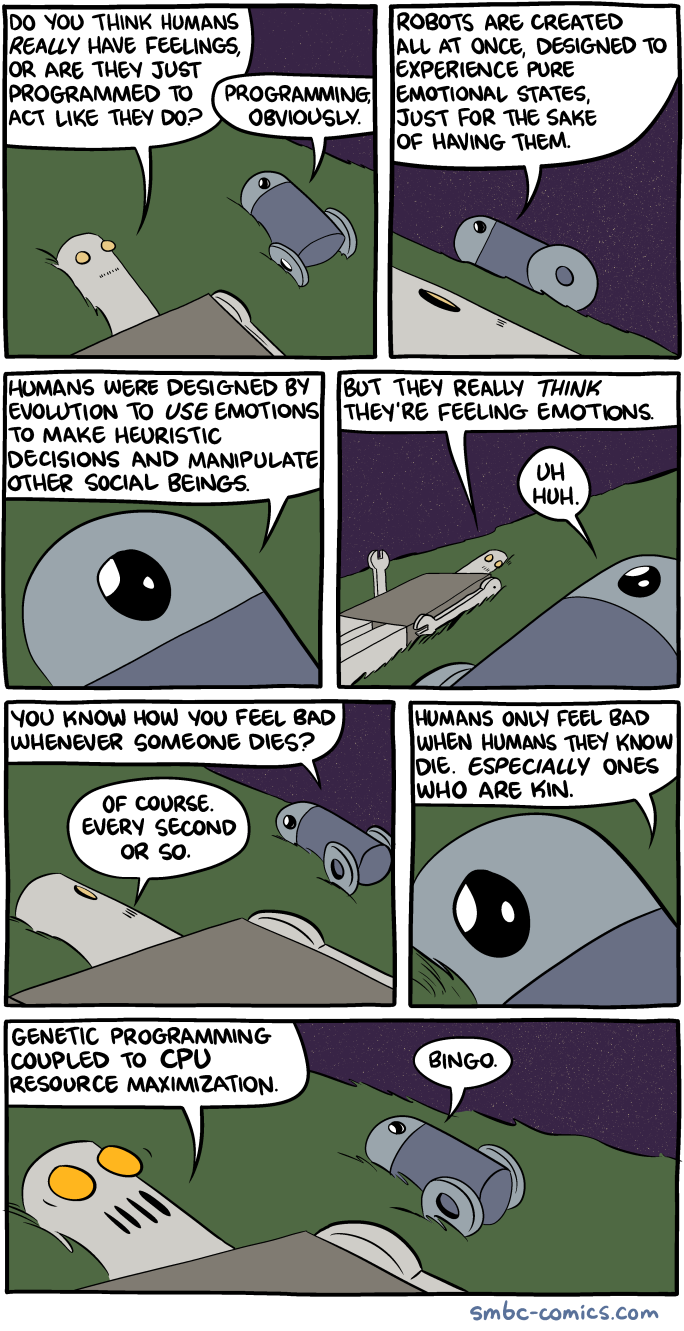
The comic presents a parallel between robots and humans, each questioning whether the other truly has feelings. A robot asks: "Do you think humans really have feelings, or are they just programmed to act like they do? Redundancy?" Meanwhile, it is noted that robots are created and designed to experience pure emotional states "just for the sake of having them." The human side mirrors this: "Humans were designed by evolution to use emotions to make heuristic decisions and manipulate other social beings." When asked if they really think they are feeling emotions, a robot simply says "Um... yes?"
The comparison deepens: a human says "You know how you feel bad whenever someone dies?" and responds "Of course, every second of every day" -- implying robots grieve all deaths universally. Humans, by contrast, "only feel bad when someone they know dies" and do not care especially about a stranger. The comic labels this "Genetic programming (analogous to CPU) -- resource maximization. Bingo."
The Humor
The comic inverts the classic philosophical question about artificial consciousness ("Do robots really have feelings?") by showing that the same skepticism applies equally to humans. When you describe human emotions in mechanistic terms -- as products of evolution designed for survival advantage rather than genuine experience -- humans sound just as "programmed" as robots. The joke highlights that human emotions are selective (we grieve people we know, not strangers), heuristic (designed for quick decisions, not truth), and manipulative (used for social leverage). These are all very "robotic" characteristics. The comic suggests that the question "do they really feel?" is equally valid and equally unsettling in both directions.
References
- Philosophy of mind: The comic engages with the "hard problem of consciousness" and the question of whether subjective experience can be reduced to mechanical processes.
- Evolutionary psychology: The view that human emotions evolved as adaptive tools for survival rather than as ends in themselves.