dollars
Explanation
The Joke
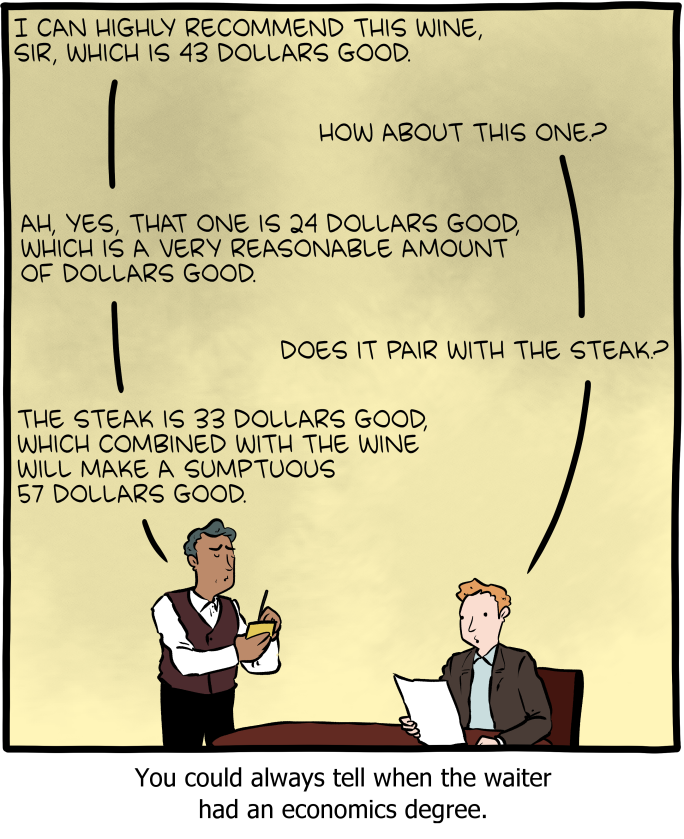
A waiter at a restaurant recommends a wine, describing it as "45 dollars good." When the customer asks about another wine, the waiter says it is "24 dollars good, which is a very reasonable amount of dollars good." The customer then asks if the wine pairs with the steak, and the waiter explains that the steak is "53 dollars good" and combined with the wine will make "a sumptuous 97 dollars good." The caption reads: "You could always tell when the waiter had an economics degree."
Humor Mechanism
The comic satirizes how economics training can reduce all qualitative experiences to quantitative monetary values. Rather than describing the wine's flavor profile, bouquet, or body — the traditional vocabulary of wine service — this waiter can only express quality in terms of price. The joke works through escalating absurdity: the first use of "dollars good" is slightly odd, the second makes the pattern clear, and the third pushes it to its logical extreme by literally summing the dollar values of food and wine to produce a combined "dollars good" rating. This is a reductio ad absurdum of the economic concept of utility, where all preferences can theoretically be expressed in monetary terms.
Context
This comic plays on the stereotype that economists see the world entirely through the lens of prices and markets — the idea that an economist "knows the price of everything and the value of nothing" (a quip often attributed to Oscar Wilde, though he originally said it about cynics). The joke also touches on the real phenomenon of "willingness to pay" as a measure of value in economics, and gently mocks the sometimes pretentious ritual of wine service at upscale restaurants by replacing it with something even more absurd: raw dollar amounts as a quality descriptor.