ducklings
Explanation
The Joke
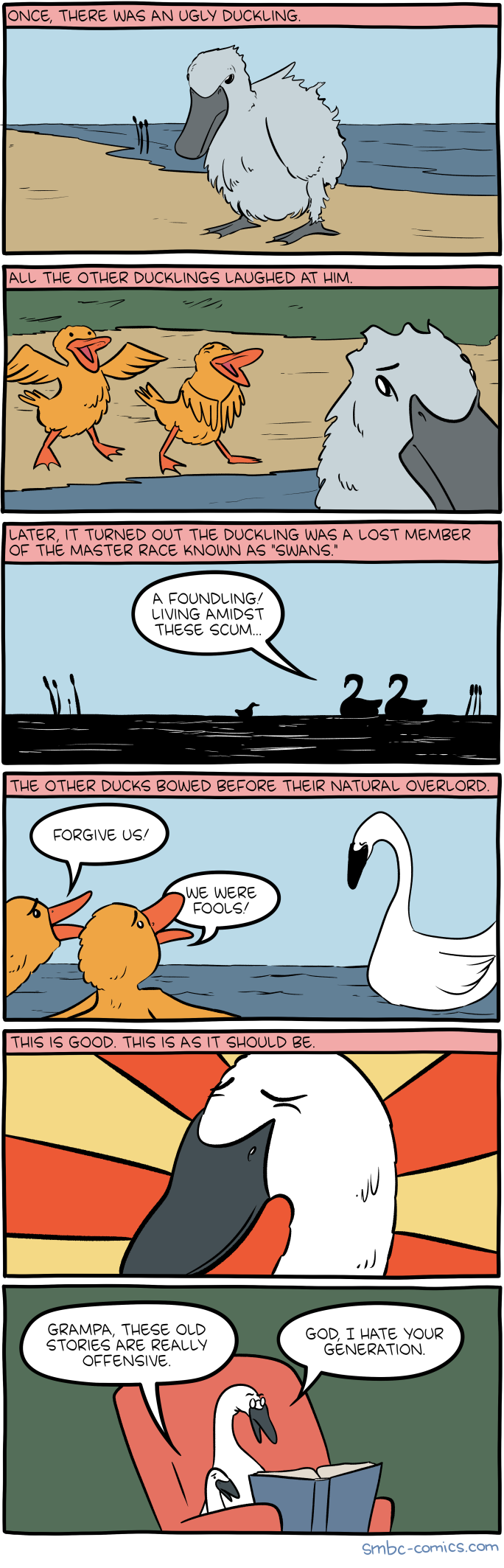
The comic retells "The Ugly Duckling" fairy tale, but with a dark satirical twist. It begins faithfully: an ugly duckling is laughed at by the other ducklings. But then the story veers off: "Later, it turned out the duckling was a lost member of the master race known as 'Swans.'" The ugly duckling declares, "A foundling, living amongst these scum," while the confused ducks look on. The other ducks then bow before the now-beautiful swan, and the swan pronounces: "This is good. This is as it should be."
In the final panel, a grandparent is reading this version of the story to a grandchild. The child says, "Grandma, these old stories are really offensive." The grandmother snaps back, "God, I hate your generation."
The comic forces the reader to notice something uncomfortable about the original "Ugly Duckling" story: its moral is not really "be yourself" but rather "don't worry, you were secretly superior all along." The swan doesn't learn to accept being different -- it turns out it was literally a member of a more beautiful, more elegant species. When rephrased using terms like "master race" and "scum," the story's implicit message of biological superiority becomes uncomfortably explicit.
The Humor
The humor operates on two levels. First, the reframing of a beloved children's story using fascist-adjacent language ("master race," subjects bowing before a superior being) is shocking because it highlights a genuinely problematic subtext that most people never notice. Second, the generational conflict in the final panel satirizes both sides: the child who finds old stories "offensive" and the grandmother who dismisses the concern. The joke is that in this particular case, the child might actually have a point -- the story really does have troubling implications when you examine it closely.
References
"The Ugly Duckling" is a fairy tale by Hans Christian Andersen, first published in 1843. It is traditionally interpreted as a story about inner beauty and perseverance, but the comic highlights an alternative reading: that the story's resolution depends entirely on the duckling's hidden genetic superiority rather than any personal growth or acceptance of difference.