dungeon-classes
Explanation
The Joke
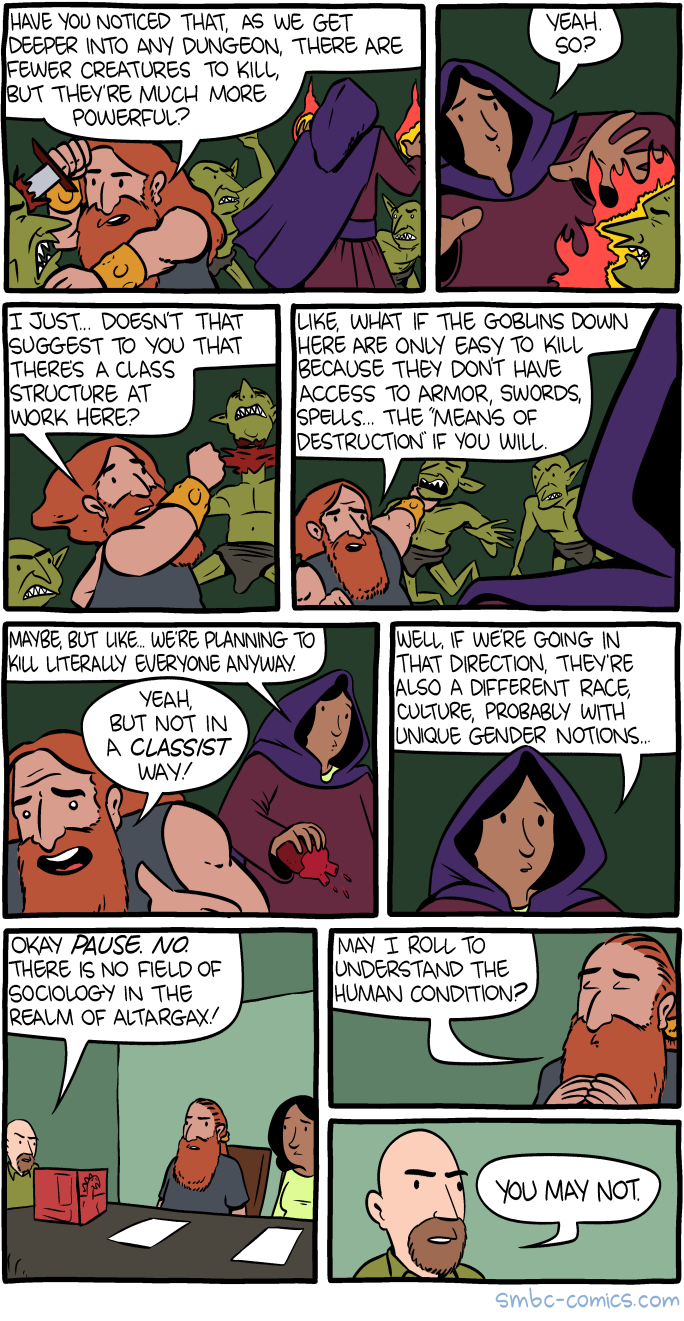
A group of fantasy adventurers are exploring a dungeon when one of them -- a hooded, fire-wielding mage -- makes an observation: as they go deeper into the dungeon, there are fewer creatures to kill, but they are much more powerful. The mage suggests this implies a class structure at work: "What if the goblins down here are only easy to kill because they don't have access to armor, swords, spells... the means of destruction, if you will."
The barbarian-type character tries to brush this off, noting they are planning to kill everyone anyway. The mage counters that it is "not in a classist way" and further points out that the creatures are also a different race and culture, "probably with unique gender notions." The conversation escalates to the point where the mage asks to "roll to understand the human condition." The scene then pulls back to reveal this is actually a tabletop role-playing game, and the Dungeon Master firmly shuts it down: "You may not."
The Humor
The comic applies modern social justice and sociological analysis to the classic structure of dungeon-crawling RPGs like Dungeons & Dragons. In these games, players routinely slaughter weaker creatures on upper levels and face stronger ones below, treating it as simple game mechanics. The mage character reframes this as a Marxist class analysis -- the weak goblins are not inherently inferior; they are simply disadvantaged by lack of access to resources ("the means of destruction," a play on "the means of production").
The final panel reveal that this is a tabletop game adds another layer: the Dungeon Master''s exasperated refusal to let the player "roll to understand the human condition" is every game master''s nightmare of a player who wants to turn a fun dungeon crawl into a sociology seminar. The comic satirizes both the unexamined moral assumptions of fantasy RPGs and the tendency of certain intellectually inclined players to overthink the game''s premises.
References
The phrase "means of destruction" is a play on Karl Marx''s concept of the "means of production," which in Marxist theory refers to the physical resources (factories, tools, land) that the ruling class controls and the working class lacks. The discussion of class structure, race, culture, and gender in the context of fantasy creatures echoes real academic critiques of fantasy literature and games, which have been analyzed for their sometimes problematic assumptions about race and civilization hierarchies. The tabletop RPG depicted appears to be Dungeons & Dragons or a similar system, given the presence of a Dungeon Master and the concept of rolling dice for actions.