dunno
Explanation
The Joke
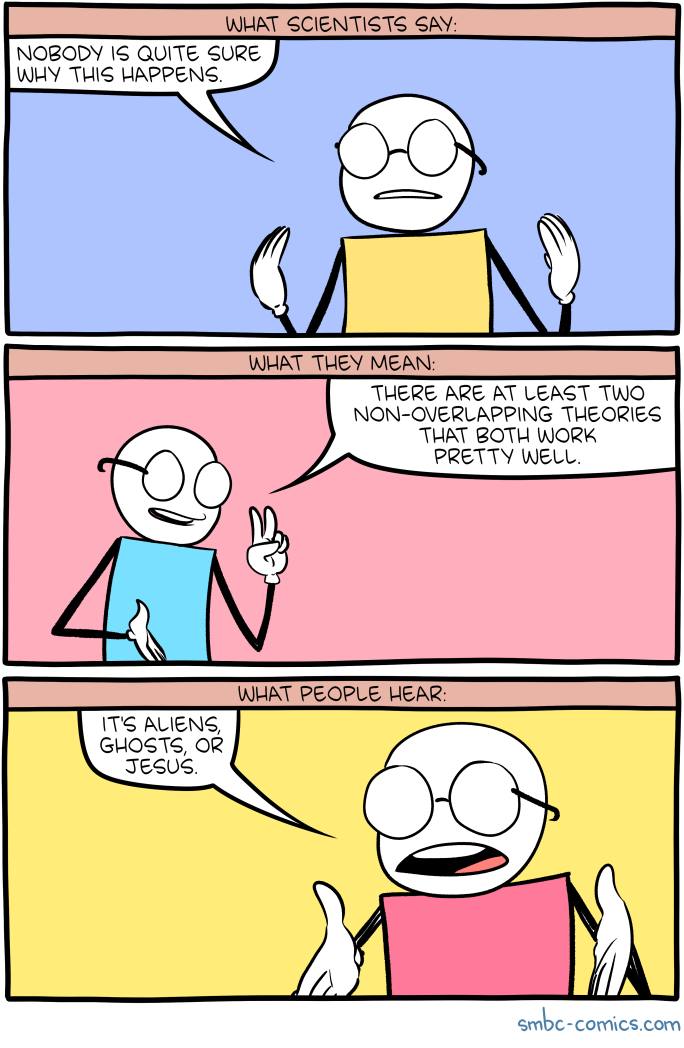
The comic presents three panels illustrating the gap between scientific communication and public understanding. In the first panel, labeled "What Scientists Say," a scientist states: "Nobody is quite sure why this happens." In the second panel, labeled "What They Mean," the same scientist explains that there are actually at least two non-overlapping theories that both work pretty well — holding up two fingers to emphasize the point. In the third panel, labeled "What People Hear," a person gleefully interprets the statement as: "It's aliens, ghosts, or Jesus."
The Humor
The joke targets a specific and well-documented communication failure in science. When a scientist says "we don't know," they typically mean the question is at the frontier of research, with multiple competing but plausible hypotheses. The public, however, often interprets scientific uncertainty as total ignorance — a blank space that can be filled with any explanation, no matter how outlandish.
The escalation from "two competing peer-reviewed theories" to "aliens, ghosts, or Jesus" captures the absurd leap that often happens in popular discourse. The excited expression on the person in the third panel is key — they're not confused or frustrated by the uncertainty, they're thrilled, because they interpret it as permission to believe whatever they want.
Broader Context
This comic addresses a recurring theme in science communication: the difference between "we don't know" as a statement of active research and "we don't know" as an admission of total cluelessness. This misinterpretation fuels pseudoscience, conspiracy theories, and the "God of the gaps" style of reasoning. Weinersmith, who frequently engages with science communication, clearly finds this gap both funny and frustrating.