economically-sensible
Explanation
The Joke
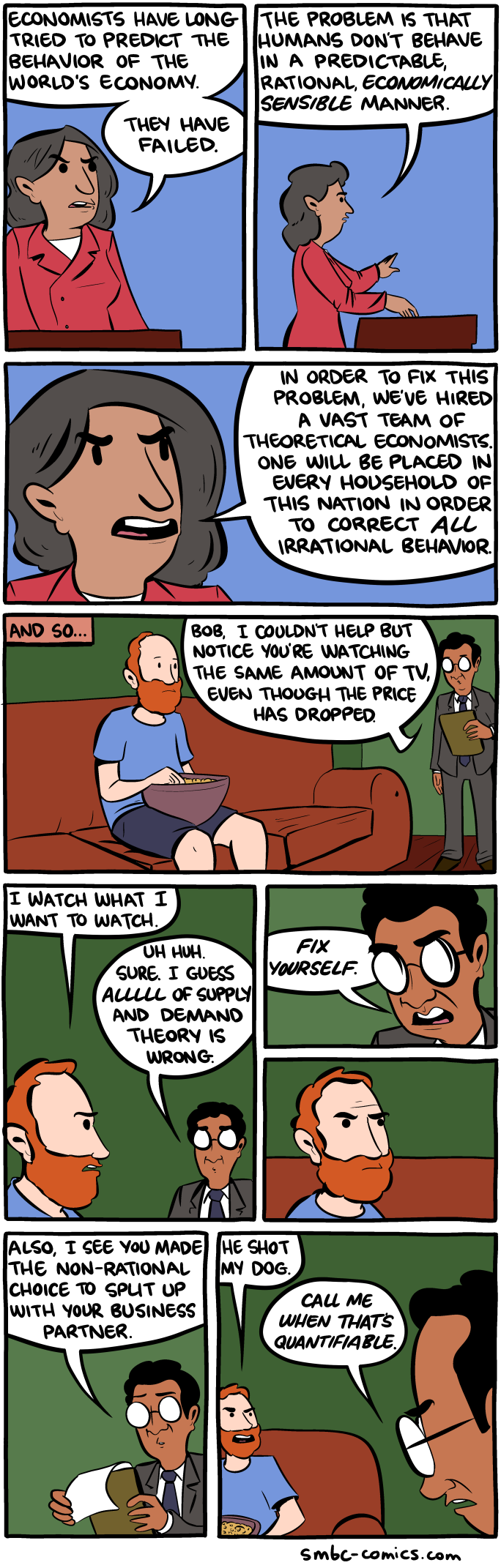
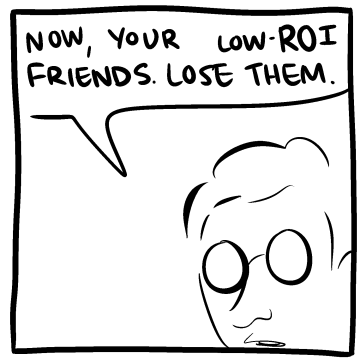
A presenter explains that economists have long tried to predict the behavior of the world's economy but have failed, because "humans don't behave in a predictable, rational, economically sensible manner." The proposed solution: hire a vast team of theoretical economists to be placed in every household in the nation to correct all "irrational behavior." In practice, this means an economist moves in with a man and starts criticizing his TV-watching habits (watching the same amount of TV even though the price has dropped, violating supply-and-demand theory) and his personal relationships (choosing to stay with a business partner for "non-rational" reasons). The man tells the economist to "fix yourself," and when the economist notes that the man "shot his dog," the man responds: "Call me when that's quantifiable."
The Humor
The comic satirizes the gap between economic theory and real human behavior. Economists assume people are rational actors who respond predictably to price signals and incentives, but actual humans make decisions based on habit, emotion, loyalty, and other "irrational" factors. The absurd solution — embedding economists in homes to enforce rational behavior — highlights how divorced economic models can be from lived experience. Each example escalates the absurdity: TV consumption, relationship choices, and finally the darkly comic non sequitur about shooting a dog, which the man dismisses because it is not "quantifiable." The joke ultimately suggests that the economists themselves are the irrational ones for believing human life can be reduced to their models.
References
- The comic references rational choice theory and supply and demand, foundational concepts in economics that assume humans act as rational, self-interested agents.
- The broader satire touches on the field of behavioral economics, pioneered by researchers like Daniel Kahneman and Richard Thaler, which studies how real human decision-making deviates from classical economic models.