econs-2
Explanation
The Joke
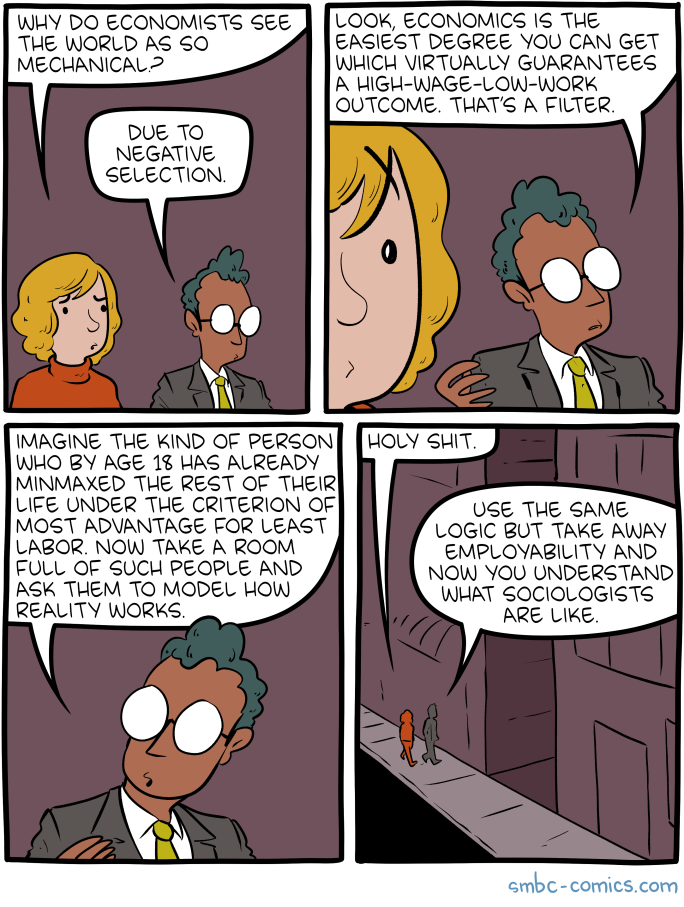
Someone asks, "Why do economists see the world so mechanically?" An economist responds, "Due to adverse selection." He then explains the logic: economics is the least useful subject for making money (since if economic models actually predicted markets, economists would just be rich traders). So by a certain age, anyone still doing economics has already demonstrated they can't exploit their knowledge for personal gain. The economist concludes that this self-selected group has "the least advantage for the least gain," making them ideally suited to model humans as perfectly rational agents.
A woman in the final panel responds: "Holy shit... use the same logic but take away the math and you understand exactly why people hate econs."
The Humor
The comic uses the concept of adverse selection — an economics term for when a selection process produces systematically skewed results — and turns it against economics itself. The joke is that the very people who end up as career economists are, by revealed preference, the worst at applying economic thinking to their own lives.
The deeper irony is that the economist perfectly diagnoses his own field's dysfunction using economic reasoning, yet this self-awareness doesn't help him escape it. The final panel's punchline adds that if you strip away the mathematical sophistication, this is exactly why the public dislikes economists — they model humans as rational while demonstrating through their own career choices that humans (including economists) are anything but.
This is a classic SMBC theme: using a discipline's own tools to critique that discipline.
Votey
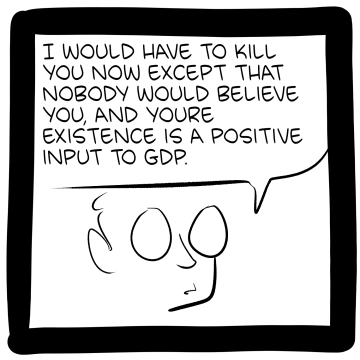
The red-button panel typically adds an additional punchline that extends or undercuts the comic's premise.