election-probability
Explanation
The Joke
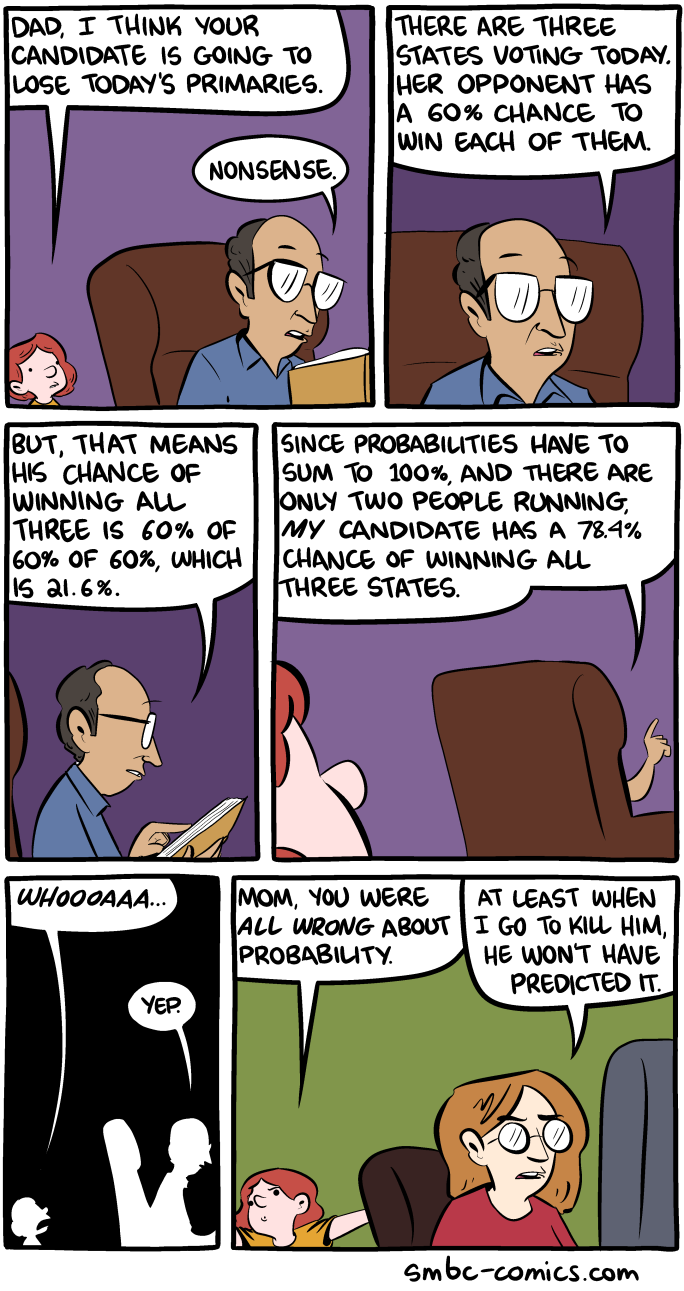
A child tells his father that he thinks their candidate is going to lose today's primaries. The father dismisses this as "nonsense" and explains: there are three states voting today, and their opponent has a 60% chance to win each of them.
The child points out: "But that means his chance of winning all three is 60% cubed, or about 21.6%." The father then proudly concludes: "Since probabilities have to add to 100%, and there are only two people running, my candidate has a 78.4% chance of winning all three states!"
This is, of course, completely wrong. The final panel shows the mother saying, "Mom, you were all wrong about probability," and the father sinisterly replies, "At least when I go to kill him, he won't have predicted it."
The Humor
The comic illustrates a common misunderstanding of probability and statistics. The father makes two distinct errors:
-
He correctly computes that the opponent's chance of winning all three states is 0.6 x 0.6 x 0.6 = 21.6%. But then he makes a critical error.
-
He assumes that because probabilities "add to 100%," the remaining 78.4% must be the probability of his candidate winning all three states. This is wrong. The complement of "opponent wins all three" is not "my candidate wins all three" -- it is "the opponent does NOT win all three," which includes many scenarios where each candidate wins some states.
The correct probability of his candidate winning all three states (at 40% per state) would be 0.4 x 0.4 x 0.4 = 6.4%, which is far worse than the father claims.
The dark punchline -- the father threatening violence when proven wrong -- satirizes how some people react to having their statistical reasoning corrected, especially in the context of partisan politics. It also plays on the stereotype of people who are confidently wrong about probability becoming hostile when challenged.
References
- This comic was published during the 2016 US presidential primary season, when probability and polling were major topics of public discussion.
- The mathematical error depicted is related to the complement rule in probability. The complement of event A is not necessarily event B unless A and B are the only two exhaustive and mutually exclusive outcomes for a single event. When multiple independent events are involved, the relationship becomes more complex.