Emotion

Explanation
The Joke
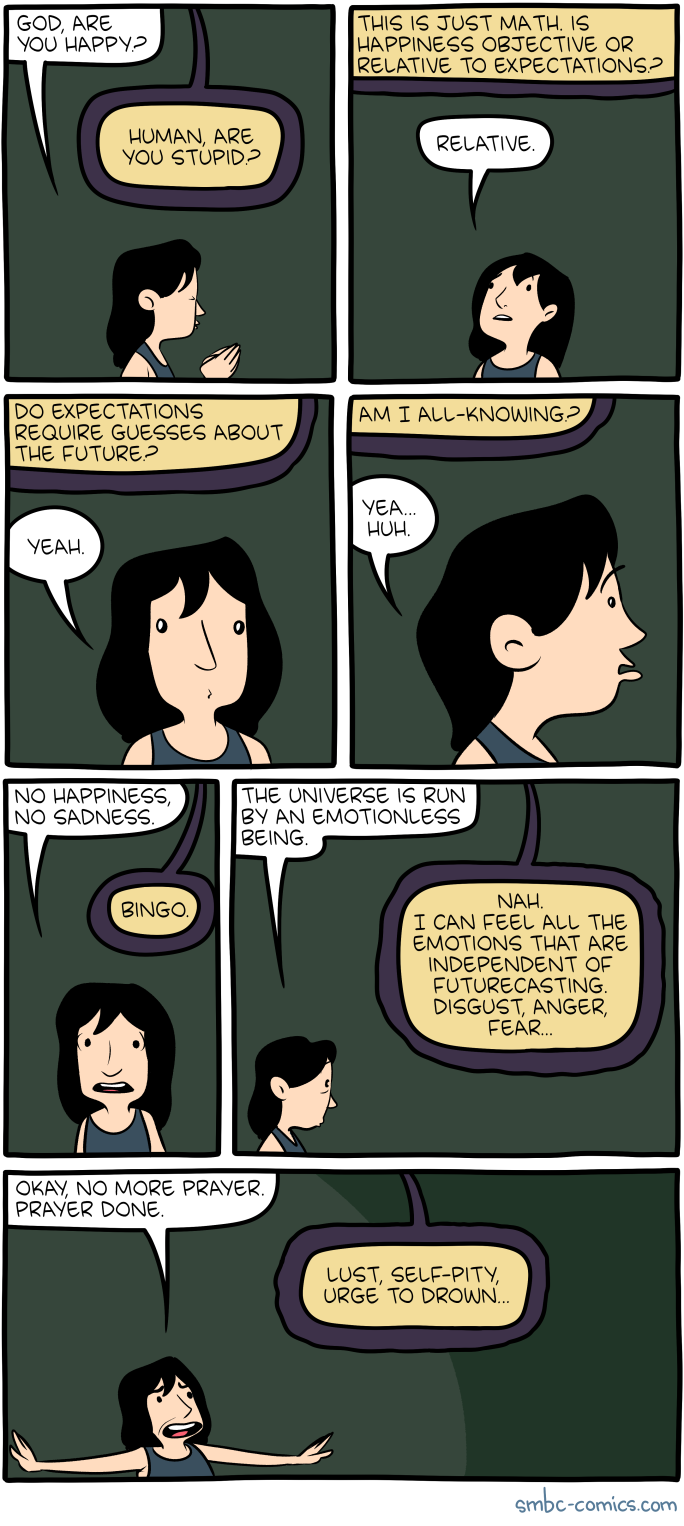
The comic depicts a conversation between God (shown with long dark hair) and a human. God asks the human, "Are you happy?" The human responds, "Are you stupid?" and explains that happiness is "just math -- whether our condition is above or relative to expectations." God asks "Relative?" and the human confirms. God then asks whether expectations include guesses about the future, and the human agrees. God asks if God is all-knowing, and the human says "Yeah."
This leads to the punchline: since God is all-knowing, God's expectations perfectly match reality, meaning there is no gap between condition and expectation. God confirms: "No happiness? No sadness?" The human says "Bingo!" Then God states, "The universe is run by an emotionless God." The human tries to backtrack, realizing the disturbing implications, and asks, "Okay no more. Maybe I picked some." But God continues: "I can feel all the emotions that are independent of expectations -- boredom, existential dread, fear." The final panel has God adding: "Just self-pity. Urge to drown."
The Humor
The comic uses a logical chain of reasoning to arrive at a deeply unsettling theological conclusion. It starts from a fairly standard psychological insight -- that happiness is relative to expectations -- and follows it to its logical extreme when applied to an omniscient being. If you know everything that will happen, nothing can exceed or fall short of your expectations, so you can never feel happy or sad. The humor lies in the step-by-step philosophical trap that the human inadvertently sets, only to realize too late that they have proven God must be a joyless, self-pitying entity with an "urge to drown" (a dark reference to the Biblical flood).
The comedic technique is a classic reductio ad absurdum combined with dramatic irony -- the human smugly explains their theory without seeing where it leads until it is too late.
References
The comic references several philosophical and theological concepts: the hedonic treadmill (the idea that happiness is relative to expectations), the problem of divine emotions in theology, and God's omniscience. The final "urge to drown" line is a dark joke referencing the story of Noah's Flood in Genesis, where God, dissatisfied with humanity, floods the Earth -- reframed here as an act of existential despair rather than righteous judgment.