empirical-economics

Explanation
The Joke
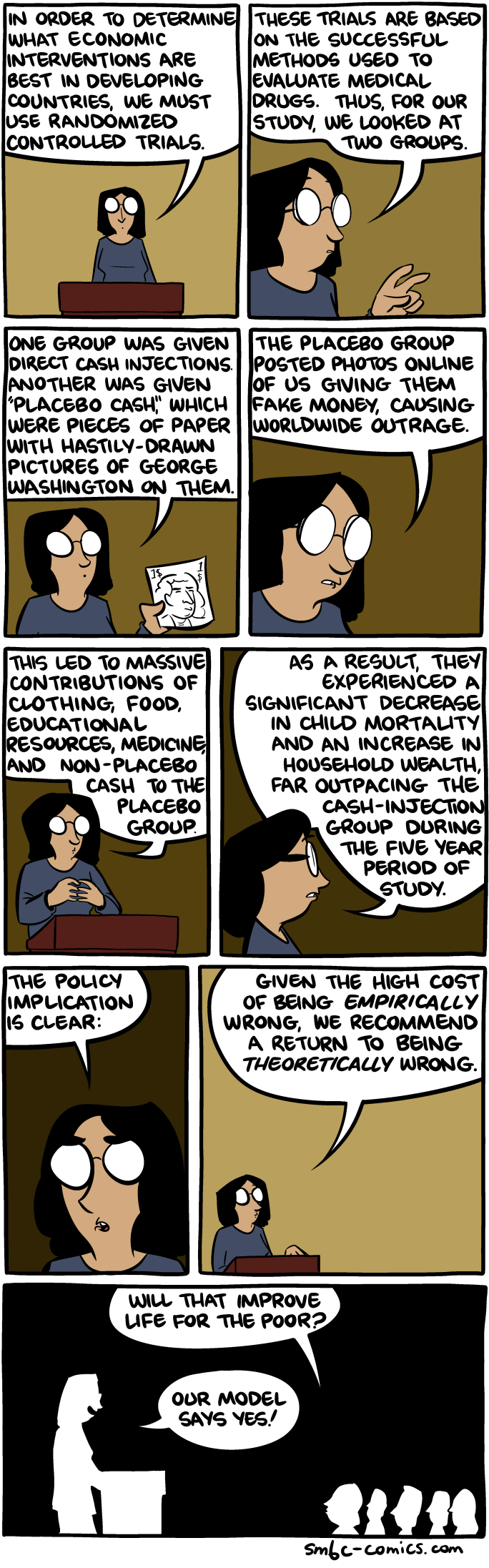
The comic depicts economists presenting the results of a randomized controlled trial on economic interventions in developing countries. They divided subjects into two groups: one received direct cash injections, while the other (the placebo group) received "placebo cash" -- worthless pieces of paper with hastily-drawn pictures of George Washington on them (i.e., crude fake money). The placebo group posted photos online showing them using the fake money, causing massive worldwide outrage, which led to an enormous outpouring of real contributions -- clothing, food, educational resources, medicine, and actual cash -- that far outpaced the direct cash injection group. The economists conclude that the "policy implication is clear: given the high cost of being empirically wrong, we recommend a return to being theoretically wrong." When asked "Will that improve life for the poor?" they respond "Our model says yes."
The Humor
The comic satirizes several things simultaneously. First, it mocks the sometimes absurd methodology of randomized controlled trials when applied to economics, particularly the concept of a "placebo" in an economic study (you cannot meaningfully give someone "placebo money"). Second, it pokes fun at how viral outrage on social media can inadvertently produce better outcomes than carefully designed interventions -- the embarrassing debacle of fake money going viral generated more aid than the actual program. Third, and most pointedly, the punchline skewers economics as a discipline: when empirical evidence produces inconvenient or embarrassing results, economists would rather retreat to purely theoretical models that tell them what they want to hear. The final exchange -- where the model says returning to theoretical wrongness will help the poor -- highlights the circular, self-validating nature of economic modeling.
References
The comic references the growing movement in development economics toward randomized controlled trials (RCTs), pioneered by economists like Esther Duflo and Abhijit Banerjee (who later won the Nobel Prize in Economics in 2019). The concept of a "placebo" is borrowed from medical research methodology, where control groups receive inert treatments. The "hastily-drawn pictures of George Washington" are a parody of U.S. dollar bills, which feature the first president's portrait.