end-times

Explanation
The Joke
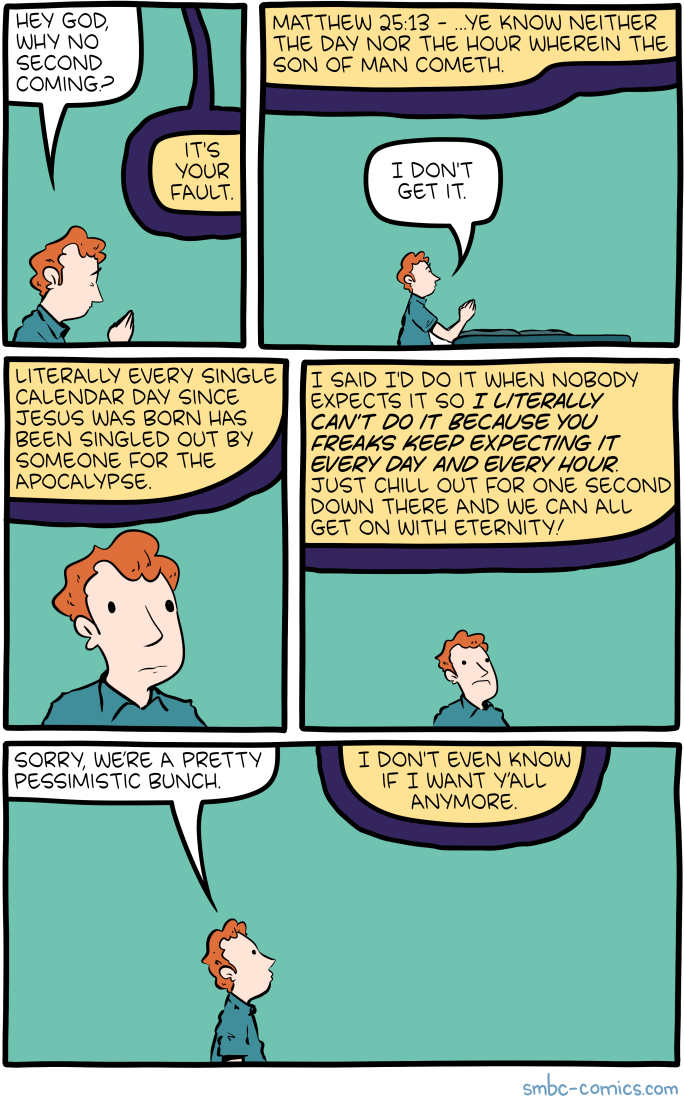
A conversation takes place about the biblical prophecy of the end times. Someone quotes Matthew 25:13 — "Ye know neither the day nor the hour wherein the Son of Man cometh" — meaning that the Second Coming could happen at any moment and nobody can predict when. Another person says "I don't get it." The first person explains: "It said to do it. It said nobody can do it because 'ye know neither the day.' But generations of Christians keep doing it every day and every hour." The response is essentially that literally every generation of Christians has predicted the end times was imminent, and they've all been wrong, and yet people keep doing it.
The final panel has someone saying "Sorry, we're a pretty forgivable bunch" and the other responding "I don't even know if that's theology anymore."
The Humor
The comic highlights the irony that the Bible explicitly says no one can predict the Second Coming, and yet predicting the Second Coming is one of Christianity's most popular pastimes. Every generation has its end-times prophets, all citing the same book that tells them they can't do what they're doing. The joke is that this is such a well-established pattern that it has essentially become a tradition rather than a theological exercise.
The final exchange is the sharpest line: "I don't even know if that's theology anymore" suggests that the practice of predicting the end times has drifted so far from its scriptural basis that it's become its own self-sustaining cultural phenomenon, unmoored from the text it claims to be based on.
Broader Context
SMBC frequently engages with religious themes, particularly the gap between what religious texts actually say and how religious communities interpret them. Weinersmith often approaches theology with genuine interest rather than dismissiveness, and this comic is more bemused than hostile — it's pointing out a funny contradiction rather than attacking belief itself.