Ending
Explanation
The Joke
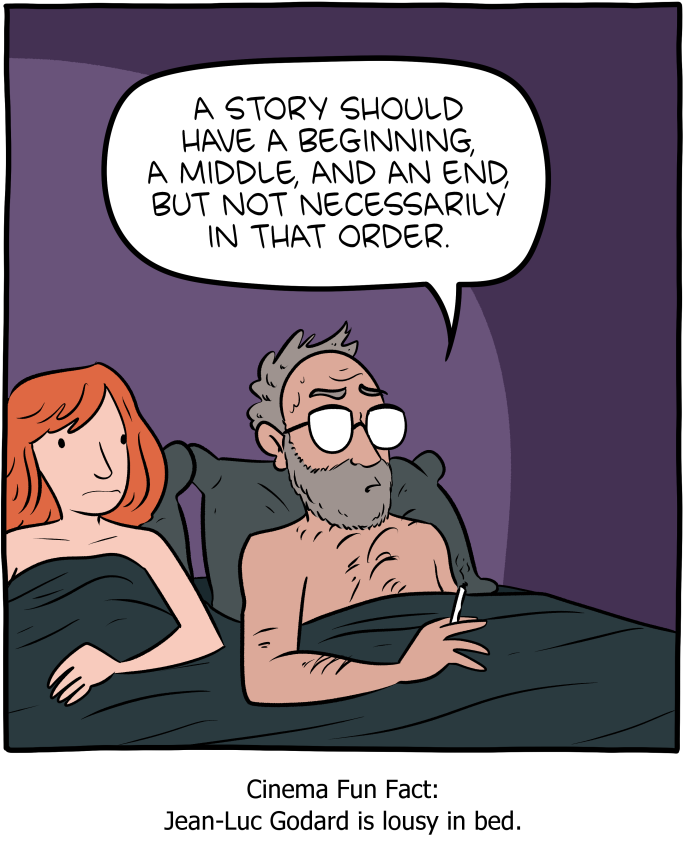
The comic shows a man in bed with a woman, post-intimacy, quoting the famous line attributed to filmmaker Jean-Luc Godard: "A story should have a beginning, a middle, and an end, but not necessarily in that order." The woman beside him looks distinctly unimpressed and dissatisfied. Below the comic panel, a caption reads: "Cinema Fun Fact: Jean-Luc Godard is lousy in bed."
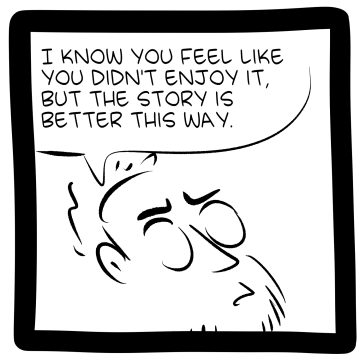
The joke operates on a double meaning. Godard's quote is about nonlinear storytelling in cinema -- he was famous for deconstructing traditional film narrative structure in the French New Wave movement. But in the context of being in bed, the quote takes on an entirely different meaning: it sounds like he is describing a chaotic, disorganized sexual performance where the "beginning, middle, and end" happen out of order, which the woman's expression confirms was not a pleasant experience.
The Humor
The comedy works through recontextualization. A perfectly respectable artistic philosophy about film structure becomes hilariously inappropriate when applied to sexual performance. The woman's annoyed, dissatisfied expression is the visual punchline that confirms the worst interpretation. There is also a layer of humor in the stereotype of the pretentious intellectual artist who treats everything, including intimate moments, as an opportunity to pontificate about art theory. The "Cinema Fun Fact" caption mimics the tone of a cheerful trivia blurb, creating a funny tonal clash with the actual content.
References
Jean-Luc Godard (1930-2022) was a pioneering French-Swiss filmmaker and one of the founders of the French New Wave cinema movement. The quote referenced in the comic is indeed widely attributed to him (though its exact origin is debated). His films, including "Breathless" (1960) and "Contempt" (1963), were known for their unconventional narrative structures, jump cuts, and breaking of the fourth wall.