Ends
Explanation
The Joke
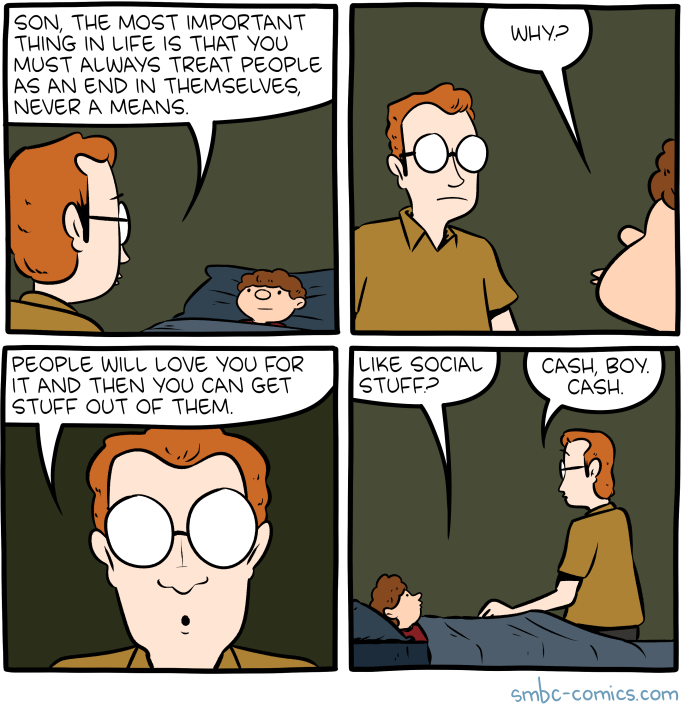
A father is tucking his son into bed and delivering a piece of moral wisdom: "Son, the most important thing in life is that you must always treat people as an end in themselves, never a means." The son asks, "Why?" The father responds, "People will love you for it, and then you can get stuff out of them." The son asks, "Like social stuff?" and the father corrects him: "Cash, boy. Cash."
The Humor
The joke is a perfect self-defeating philosophical argument. The father begins by paraphrasing Immanuel Kant's categorical imperative -- one of the most famous principles in moral philosophy -- which states that you should never treat people merely as a means to an end, but always as ends in themselves. This is meant to be a principle of genuine moral respect for other people's inherent dignity. However, the father immediately undermines the entire principle by framing it as an instrumental strategy: treat people as ends in themselves so that they will love you so that you can exploit that love for personal gain. In other words, he's recommending that you treat people as ends... as a means to your own ends. The final exchange about "cash" rather than "social stuff" drives the contradiction home even further, revealing the father's advice to be purely mercenary. The bedtime setting adds to the comedy, as this is presented as heartfelt fatherly wisdom.
References
The comic directly references Immanuel Kant's second formulation of the categorical imperative from his "Groundwork of the Metaphysics of Morals" (1785): "Act in such a way that you treat humanity, whether in your own person or in the person of any other, never merely as a means to an end, but always at the same time as an end." The joke is a textbook example of a pragmatic or consequentialist corruption of deontological ethics -- using a rule about intrinsic moral duty as a tool for self-interested outcomes, which is precisely what Kant argued against.