entropy
Explanation
The Joke
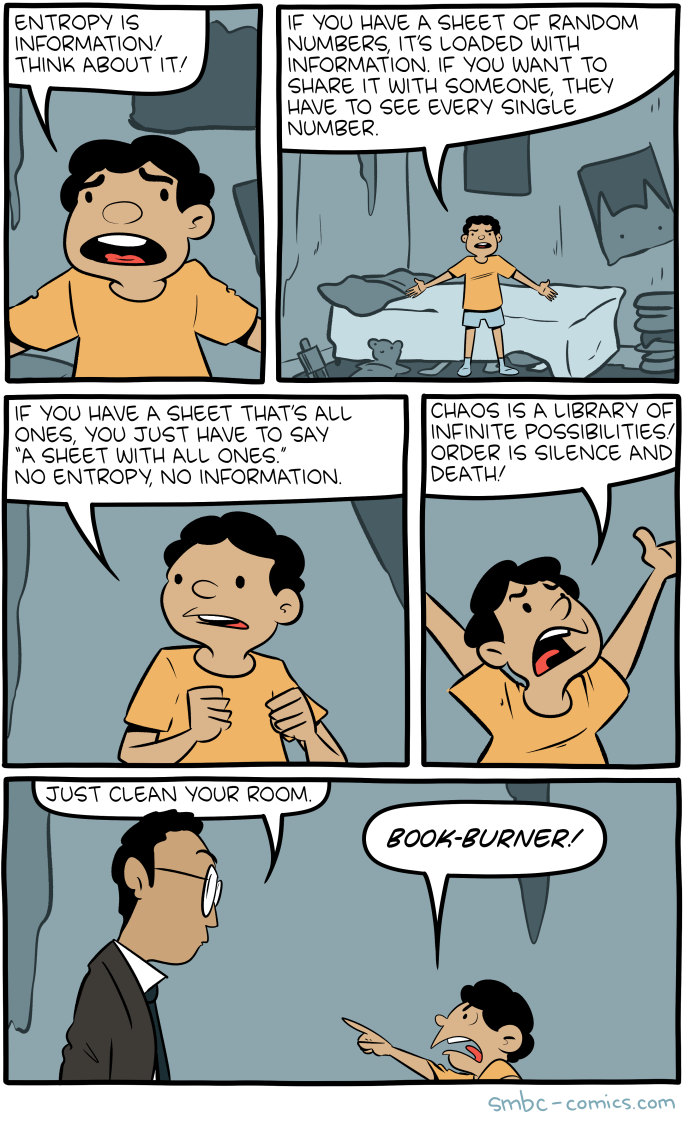
A father is trying to explain entropy to his child using an analogy. He explains that if you have a sheet of random numbers, it is packed with information -- if you want to convey it, you have to communicate every single number. But if you have a sheet that is all zeros, you can simply say "a sheet with all zeros" -- that is low entropy, and low information. He then extends the analogy: chaos is a library of random books, while order is "blonde and death." The child, taking the lesson to its logical conclusion, tells the father to "just clean your room," to which the father screams "BOOK-BURNER!"
The punchline works because the father's own analogy backfires on him. His explanation of entropy -- that high entropy (disorder) contains more information while low entropy (order) contains less -- is scientifically accurate. But when the child applies this reasoning practically by suggesting the father clean his messy room (reducing entropy/disorder), the father dramatically accuses the child of being a "book-burner," equating tidying up with the destruction of information.
The Humor
The comic humorously captures the tension between theoretical understanding and practical application. The father clearly enjoys the intellectual elegance of entropy as a concept and uses it as a justification for his own messiness -- after all, his cluttered room contains more "information" than a clean one. The child's blunt, practical response deflates the father's intellectual posturing. The accusation of "book-burner" is an absurd overreaction that compares cleaning a room to one of history's most notorious acts of anti-intellectualism, which is funny precisely because it reveals the father was using physics to rationalize laziness all along.
References
Entropy is a concept from thermodynamics and information theory. In information theory (as formulated by Claude Shannon), a message with high entropy contains more information because it is less predictable. The father's explanation is a reasonably accurate simplified version of Shannon entropy. The "book-burner" accusation alludes to historical book burnings, often associated with censorship and the destruction of knowledge.