epsilon

Explanation
The Joke
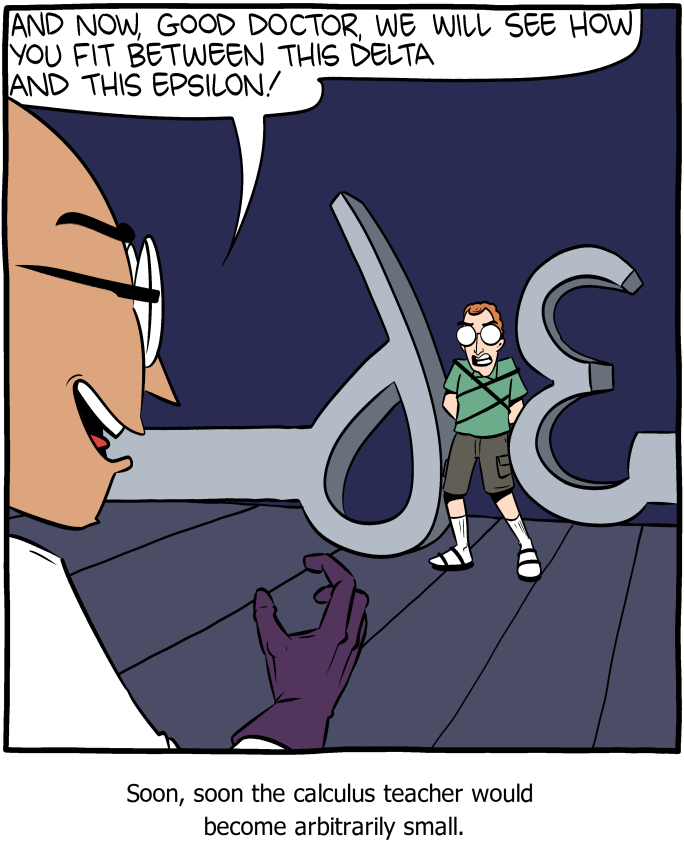
A villain has captured a calculus teacher and is torturing them by squeezing them between two giant physical versions of the Greek letters delta and epsilon. The villain announces, "And now, good Doctor, we will see how you fit between this delta and this epsilon!" The caption reads: "Soon, soon the calculus teacher would become arbitrarily small."
The joke is a pun on the epsilon-delta definition of a limit in calculus. In mathematics, for any epsilon (no matter how small), there exists a delta such that a function's value can be made arbitrarily close to the limit. The phrase "arbitrarily small" is standard mathematical terminology meaning "as small as you want." Here, it is applied literally: the calculus teacher is being physically crushed between the two symbols and will become arbitrarily small -- both in the mathematical sense (approaching zero) and in the literal sense (being squished).
The Humor
The humor lies in the literalization of abstract mathematical concepts into a physical torture scenario. The epsilon-delta definition is notoriously the first major conceptual hurdle in calculus, where students must grapple with the idea that for any given epsilon greater than zero, you can find a delta such that... and so on. By turning this into a James Bond-style villain trap where the victim is physically squeezed between giant versions of the symbols, the comic transforms one of mathematics' most elegant but intimidating definitions into slapstick violence. The phrase "arbitrarily small" -- which in math means "as small as desired" -- takes on a darkly comic double meaning.
References
The epsilon-delta definition of a limit was formalized by Karl Weierstrass in the 19th century and is foundational to rigorous calculus. It states that a function f(x) approaches a limit L as x approaches a value c if for every epsilon > 0, there exists a delta > 0 such that whenever 0 < |x - c| < delta, then |f(x) - L| < epsilon. The definition is often the first encounter calculus students have with formal mathematical proof, and "epsilon-delta proofs" are a common source of difficulty and frustration in introductory analysis courses.