equal
Explanation
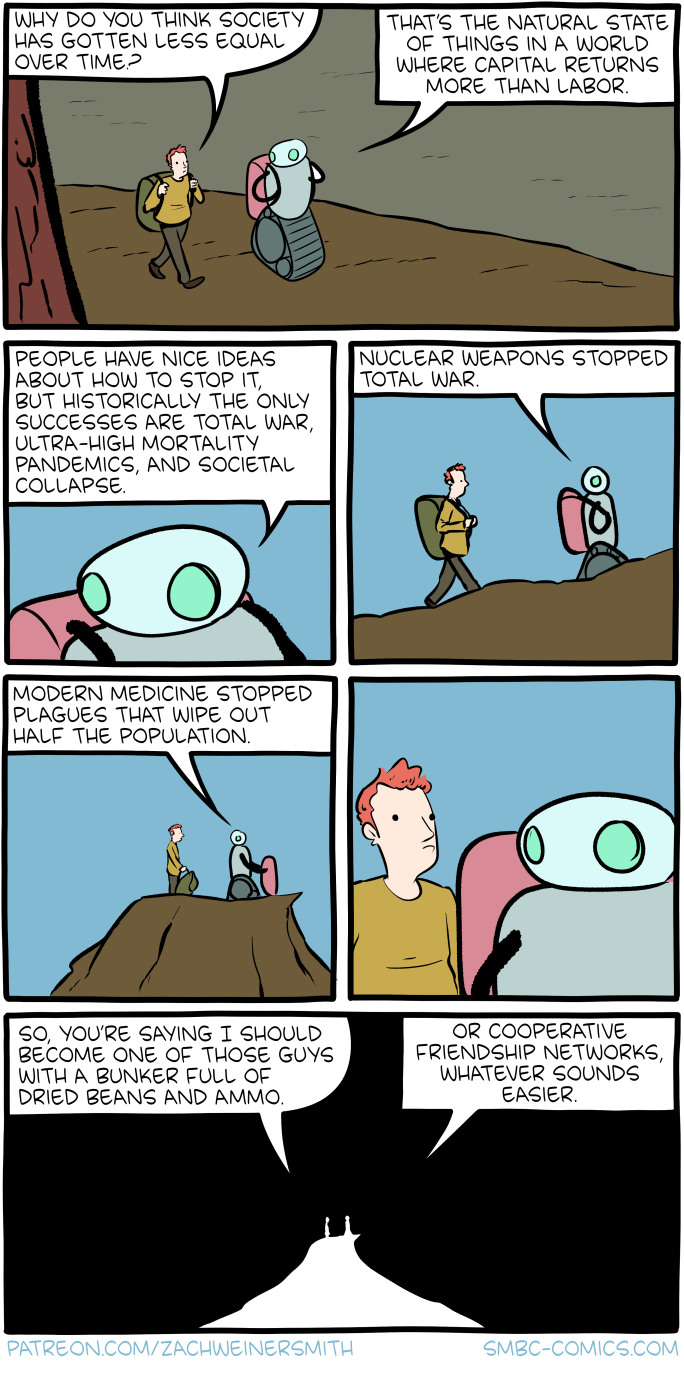
This comic is a dark, multi-panel exploration of equality, wealth, and civilizational collapse.
In the opening panels, one character asks another why goods have gotten less equal over time. The response invokes the "natural state of things in a world where capital returns more than labor" -- a direct reference to Thomas Piketty's central thesis from Capital in the Twenty-First Century, which argues that when the rate of return on capital exceeds economic growth (r > g), wealth inequality inevitably increases.
The conversation then lists historical counterexamples -- events that did reduce inequality. But these turn out to be uniformly catastrophic: nuclear weapons stopped major wars (but only through the threat of annihilation), total war and plagues and societal collapses reduced inequality by destroying wealth and killing populations, and modern medicine stopped diseases that had previously wiped out large portions of the population.
The punchline comes when one character concludes: "So you're saying I should become one of those guys living in a bunker full of dried beans and ammo." The other responds with "Or cooperative friendship and mutual aid or whatever sounds harder," delivered with obvious sarcasm about which option people actually find more appealing.
The humor is bleak but incisive. The comic points out that historically, the main forces that have reduced inequality have been catastrophic events -- wars, plagues, and collapses -- rather than deliberate policy. This is drawn from Walter Scheidel's book The Great Leveler, which argues that mass violence and catastrophe have been the primary equalizers throughout history. The final exchange jokes that building cooperative social structures is apparently harder for people to contemplate than literal apocalypse prepping, satirizing both survivalist culture and humanity's difficulty with collective action.