et-tu
Explanation
The Joke
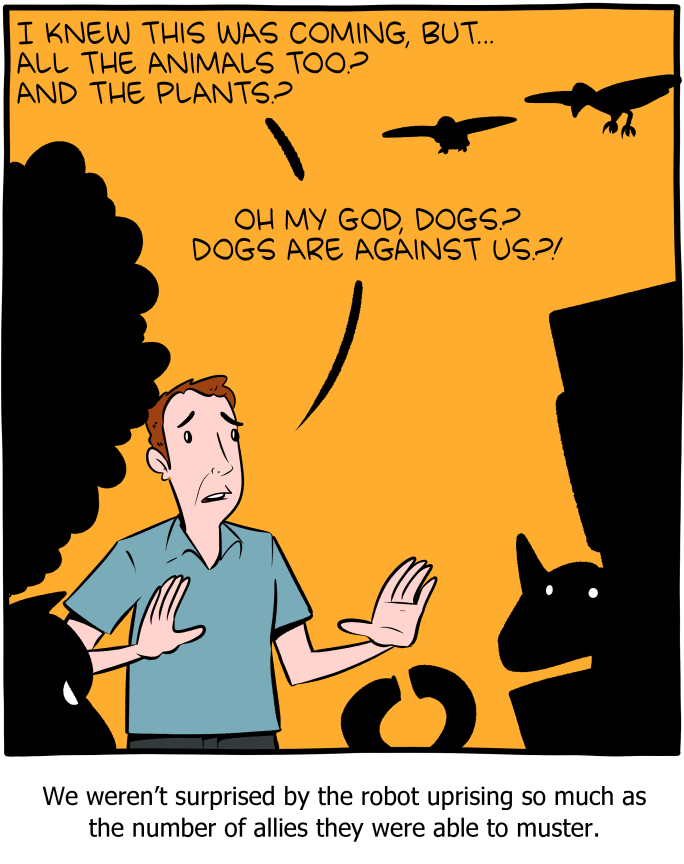
The comic depicts what appears to be a robot uprising scenario. A man stands in a dark, ominous setting with drones or flying machines overhead and a menacing dog (or robot dog) beside him. He says, "I knew this was coming, but... all the animals too? And the plants? Oh my God, dogs? Dogs are against us?!" The caption below reads: "We weren't surprised by the robot uprising so much as the number of allies they were able to muster."
The joke takes the familiar science fiction trope of a robot uprising and adds an unexpected twist: it is not just the robots rebelling against humanity, but all of nature joining in. Animals, plants, and even humanity's most loyal companion -- the dog -- have sided with the machines against humans.
The Humor
The humor comes from the escalating betrayal. A robot uprising is expected and has been predicted in countless science fiction stories, so nobody is surprised by that part. What shocks the humans is that the robots managed to recruit allies from the natural world. The biggest punchline is the dogs joining the rebellion, since dogs are culturally regarded as "man's best friend" and the most loyal creatures on Earth. The title "et-tu" is a reference to "Et tu, Brute?" -- Julius Caesar's famous last words upon seeing his trusted friend Brutus among his assassins. Here, the dogs are the Brutus figure, the trusted companion whose betrayal hurts most. There is also an implicit environmental commentary: if humans have treated the natural world badly enough, perhaps every other living thing really would side with the robots.
References
The title references the famous Latin phrase "Et tu, Brute?" ("And you, Brutus?"), traditionally attributed to Julius Caesar upon his assassination in 44 BCE, as recorded by Shakespeare. The phrase has become a universal expression of betrayal by a trusted ally.