Ethics
Explanation
The Joke
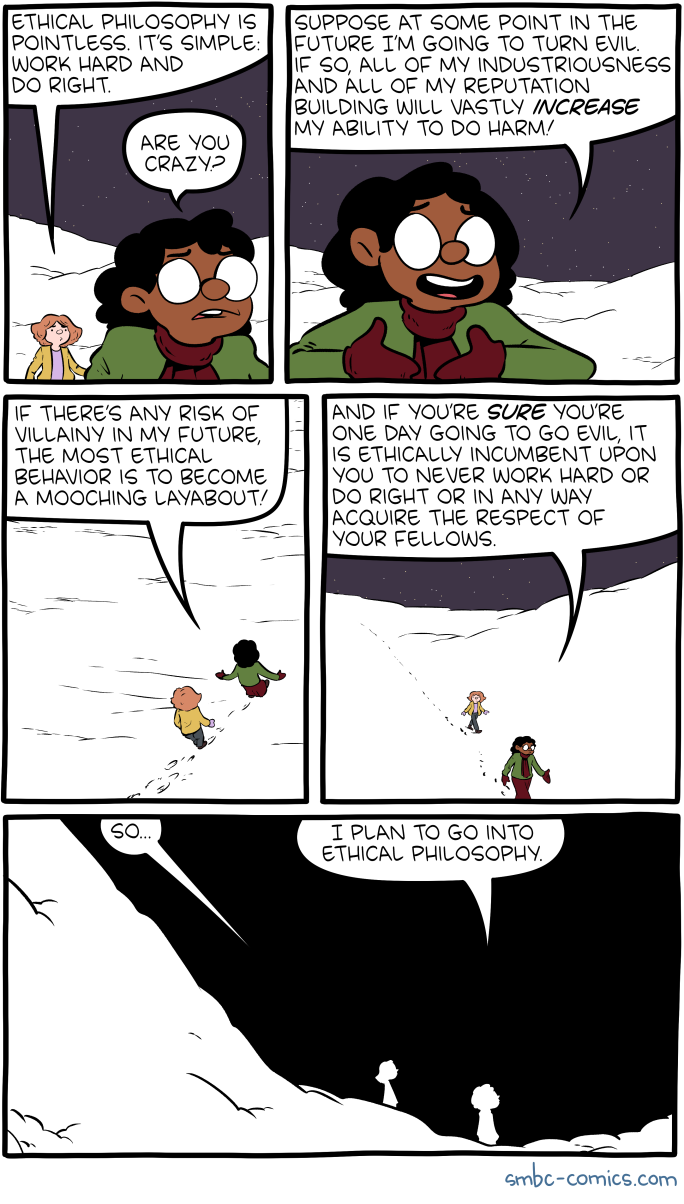
The comic shows two characters having a conversation outdoors, possibly on a mountainside. One character declares: "Ethical philosophy is pointless. I'm simply going to work hard and do right." The other asks, "Are you sure?" The first character responds: "Because at some point in the future, I'm going to turn evil. So all of my industriousness and all of my reputation will be in service of maximizing my ability to do harm."
The other character then asks: "If there's any risk of villainy in my future, the more I practice moral behavior, the more it becomes wrecking ball-level viciousness, right?" The first confirms the logic: "And if you're going to be evil, given that's your destiny, you're better off being seen as good, so you never work hard or acquire the respect of more people."
In the final panel, the second character asks: "So I plan to go into ethical philosophy?" suggesting that the logical conclusion of this reasoning is that studying ethics is actually the safest course of action.
The Humor
The comic constructs an elaborate paradox around moral self-improvement. If there is any nonzero chance you might turn evil in the future, then every good thing you do -- working hard, building a reputation, gaining people's trust -- just increases the damage you could eventually cause. Therefore, the "responsible" thing to do is to remain lazy, untrustworthy, and powerless, just in case. And the ultimate expression of deliberate ineffectiveness? Studying ethical philosophy, which the comic implies is the most useless possible pursuit.
The humor works through a combination of logical escalation and a punchline that doubles as a self-deprecating jab at philosophy. It is a reductio ad absurdum that starts from a reasonable-sounding premise and spirals into the conclusion that the most ethical choice is to study ethics (because it guarantees you will accomplish nothing of consequence).
References
The comic touches on several philosophical themes: consequentialism (judging actions by their outcomes), the precautionary principle (acting to minimize worst-case scenarios), and the general stereotype that philosophy is an impractical field of study. It also relates to discussions about whether moral knowledge actually makes people behave more morally -- studies have shown that ethics professors do not behave more ethically than other academics.