Evidence
Explanation
The Joke
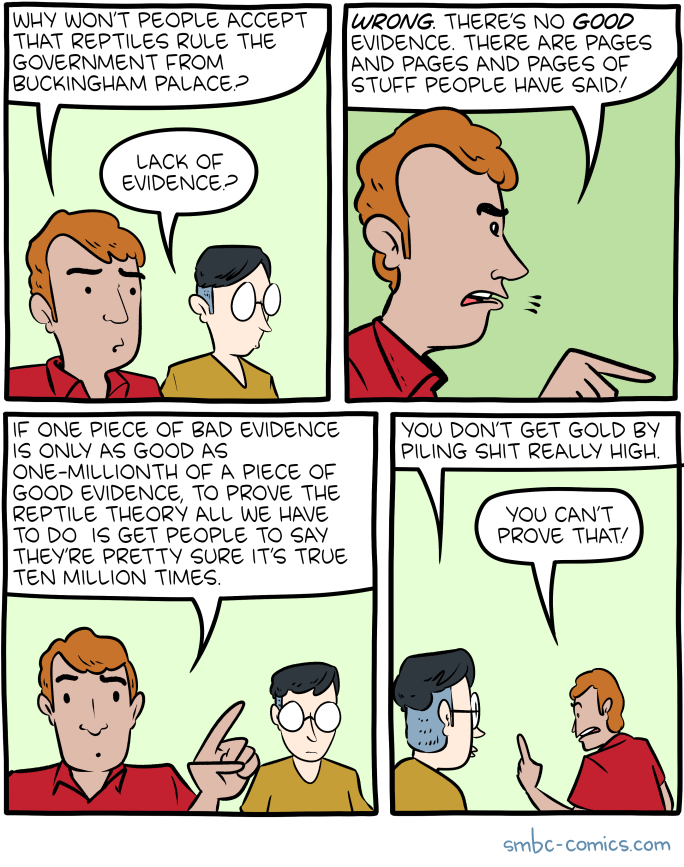
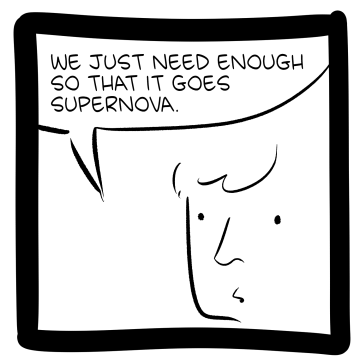
A conversation unfolds about why people do not accept certain scientific or factual claims. One person asks why people will not accept something despite all the evidence. Another suggests it is a "lack of evidence." The first person pushes back, arguing that if one piece of evidence does not convince someone, maybe a billionth of a piece will -- sarcastically pointing out that people have spent years trying to convince skeptics and it has not worked despite showing evidence "ten million times."
The final panel delivers the punchline: "You don't get sold by proof. You get sold by beauty." The other person responds, "You don't prove that," to which the first replies, "I don't have to." This is a self-demonstrating joke -- the claim that persuasion works through aesthetic appeal rather than evidence is itself presented without evidence, and the speaker openly admits this, proving the point by example.
The Humor
The comic is cleverly self-referential. The argument that people are convinced by beauty and elegance rather than raw evidence is itself presented beautifully rather than with evidence -- and the speaker acknowledges this with a knowing wink. It satirizes the frustration of science communicators and rationalists who believe that simply presenting more data should change minds, when in reality human persuasion is far more complex and aesthetic. The final exchange is a logical paradox played for laughs: if the claim is true, it does not need proof; if it is false, proof would not help anyway.
References
The comic touches on epistemology (the study of knowledge and belief) and the psychology of persuasion. It references the well-documented "backfire effect" and "belief perseverance" in psychology, where presenting contradictory evidence can actually strengthen existing beliefs. The idea that beauty and elegance are persuasive in science echoes concepts from philosophy of science, particularly the notion of "elegance" as a criterion for theory selection, as discussed by thinkers like Thomas Kuhn and Paul Dirac.