Evolution

Explanation
The Joke
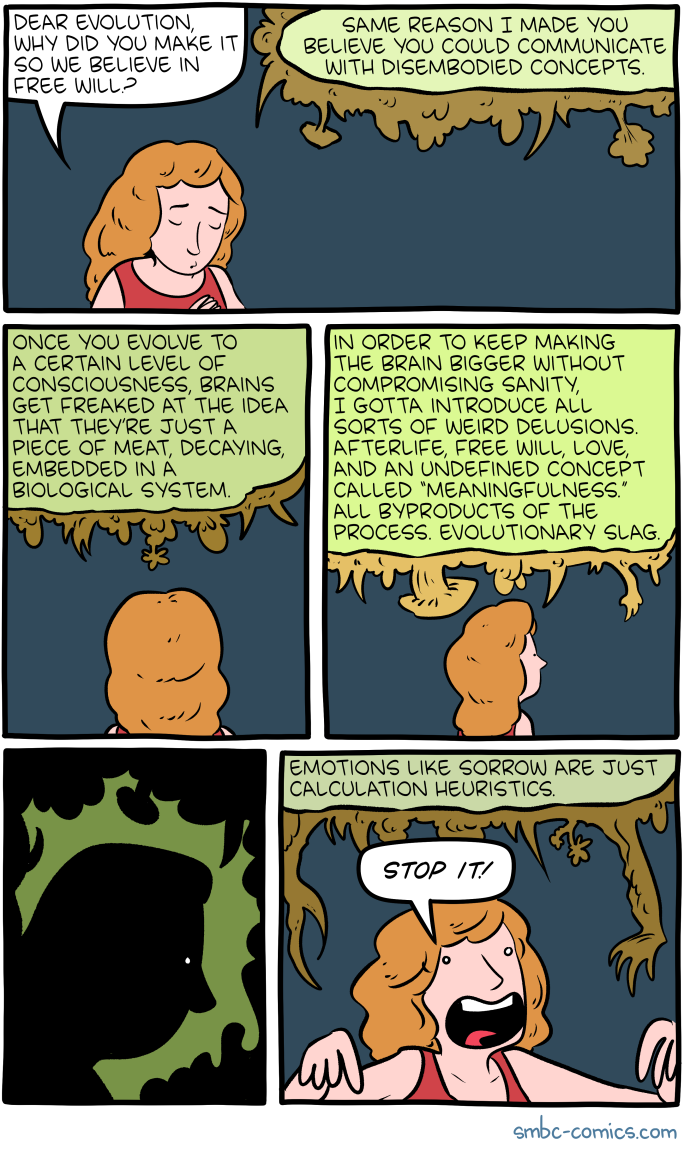
The comic features a conversation between a human and what appears to be a personified version of Evolution (depicted as a green, amorphous, blob-like entity). The human asks: "Dear Evolution, why do you make us believe in things that are not real?" Evolution responds: "Same reason I made you: so you could communicate with disembodied concepts."
The human presses further, and Evolution explains: "In order to keep making the brain bigger without needing to start over, I gotta introduce all sorts of side effects -- surplus pattern recognition, spurious agency detection, and an undefined concept humans have assigned an impressive but purely evolutionary slag term to." The human asks what term, and Evolution responds with something like "consciousness" or "soul."
The final panel shows something like: "Emotions like Gordon, Mr. 200 IQ, stop it!" with a human reacting in frustration.
The Humor
The comic personifies Evolution as a somewhat exasperated engineer who has to explain the bugs in human cognition. The fundamental joke is that many of humanity's most cherished features -- belief in the supernatural, the sense of having a soul, pattern recognition that leads to superstition -- are not grand design features but side effects (bugs) of Evolution's hack job of making brains bigger without starting from scratch.
The comedic technique is anthropomorphizing a blind natural process as a frustrated craftsperson defending their shoddy workmanship. It is funny because it reframes profound existential questions ("Why do we believe in God?") as technical complaints to a lazy developer ("Why does your software have so many bugs?").
References
The comic references several concepts from evolutionary psychology and cognitive science: pareidolia and hyperactive pattern recognition (seeing faces in clouds, etc.), hyperactive agency detection (the tendency to attribute events to intentional agents), and the "spandrels" concept from Stephen Jay Gould -- the idea that some traits are not adaptations but byproducts of other evolutionary changes. The notion that religious belief is a byproduct of cognitive adaptations that were useful for survival is a well-known hypothesis in the cognitive science of religion, championed by scholars like Pascal Boyer and Daniel Dennett.