excelsior
Explanation
The Joke
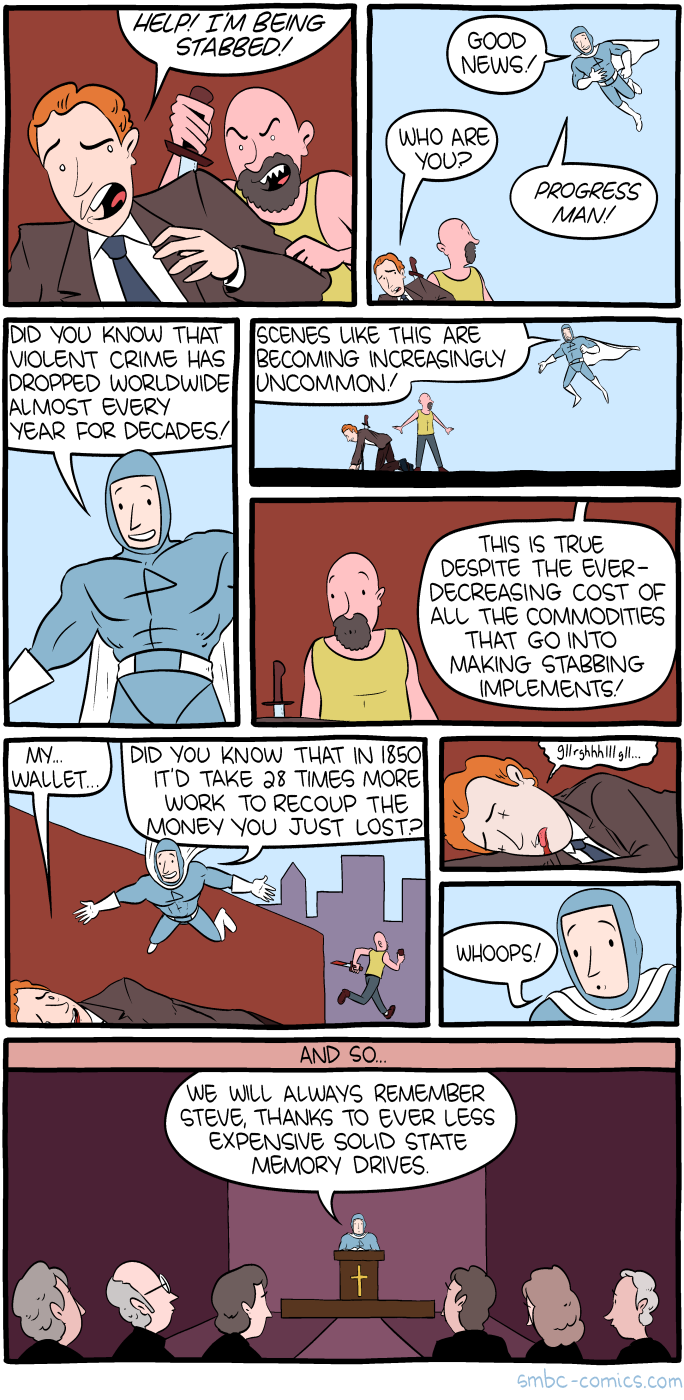
A man is being stabbed and cries out, "Help! I'm being stabbed!" A bystander delivers "good news" -- he introduces himself as "Progress" and explains that violent crime has been declining for almost every decade over the past several decades. A second person chimes in that this is true despite the ever-decreasing cost of stabbing implements (knives and such have gotten cheaper). The victim, still being stabbed, sarcastically responds, "I... yay?" The next panel adds that it takes a person 2-3 years of work to recoup the money they just lost (presumably from medical bills or theft). The final panel shows a memorial service where a speaker says, "We will always remember him as a big, expensive solid state memory drive" -- implying the victim died, and the eulogy is absurdly about technology rather than the person.
The Humor
The comic satirizes the way people use broad statistical trends to dismiss individual suffering. Yes, violent crime rates have been declining overall, and yes, the cost of many goods has decreased -- but none of that matters to the person who is currently being stabbed. The bystander character "Progress" represents the kind of optimist who responds to any specific problem by citing aggregate data showing things are getting better on average. The victim's suffering is rendered irrelevant by macro-level statistics. The joke escalates with each panel, piling on more tone-deaf "good news" while the man is literally dying. The final panel's non sequitur eulogy about a "solid state memory drive" adds an extra layer of absurdity, suggesting that in a world obsessed with technological progress, even death is reframed in terms of gadgets.
References
- The title "Excelsior" (Latin for "ever upward") is a motto associated with progress and optimism, famously used as the New York State motto and by Stan Lee as his personal catchphrase.
- The decline in violent crime over recent decades is a well-documented statistical trend, popularized by Steven Pinker in "The Better Angels of Our Nature" (2011).