Exclusive
Explanation
The Joke
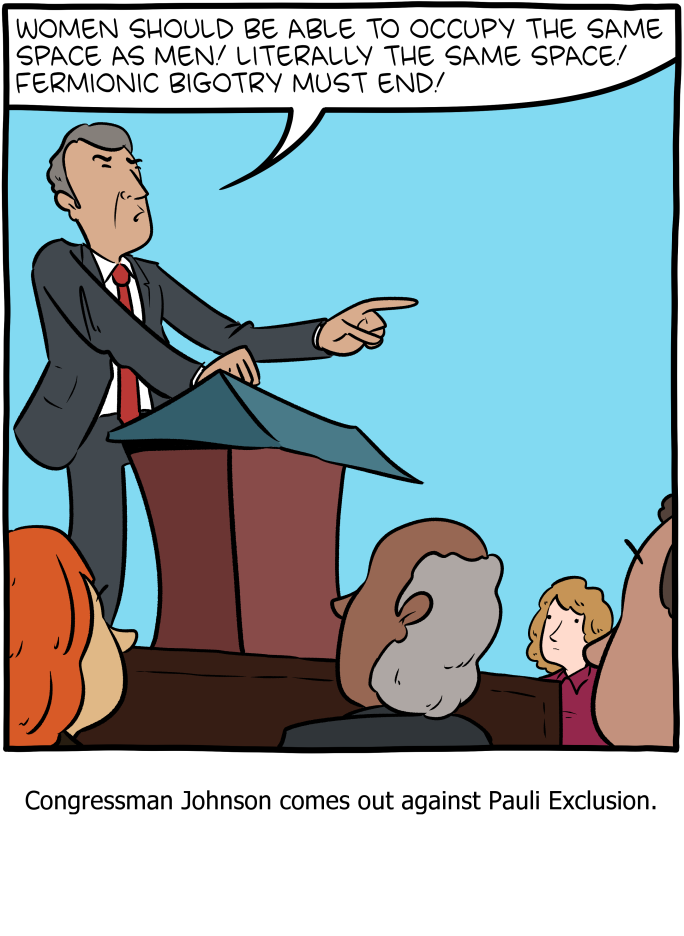
A politician stands at a podium passionately declaring: "Women should be able to occupy the same space as men! Literally the same space! Fermionic bigotry must end!" The caption reads: "Congressman Johnson comes out against Pauli Exclusion."
The comic takes the social justice concept of women occupying the same spaces as men (boardrooms, positions of power, etc.) and applies it literally to physics. In quantum mechanics, the Pauli Exclusion Principle states that no two fermions (particles like electrons, protons, and neutrons -- the particles that make up ordinary matter) can occupy the same quantum state simultaneously. This is fundamentally why matter takes up space and why two objects cannot pass through each other. The congressman treats this law of physics as a form of discrimination -- "fermionic bigotry."
The Humor
The joke is a classic SMBC physics pun that works by mapping the language of social equality onto the language of particle physics. The absurdity of a politician campaigning against a fundamental law of nature as if it were an unjust social policy is the core of the humor. The term "fermionic bigotry" is particularly funny because it sounds like it could be a real social justice term, but refers to the behavior of subatomic particles. If the Pauli Exclusion Principle were actually abolished, all matter would collapse into a single point -- making this perhaps the most catastrophic political platform ever proposed.
References
The Pauli Exclusion Principle was formulated by physicist Wolfgang Pauli in 1925. It is one of the most fundamental principles in quantum mechanics, explaining the structure of atoms, the stability of matter, and the periodic table of elements. Fermions (named after Enrico Fermi) are particles with half-integer spin that obey this principle, in contrast to bosons (named after Satyendra Nath Bose), which can share quantum states freely.