existence
Explanation
The Joke
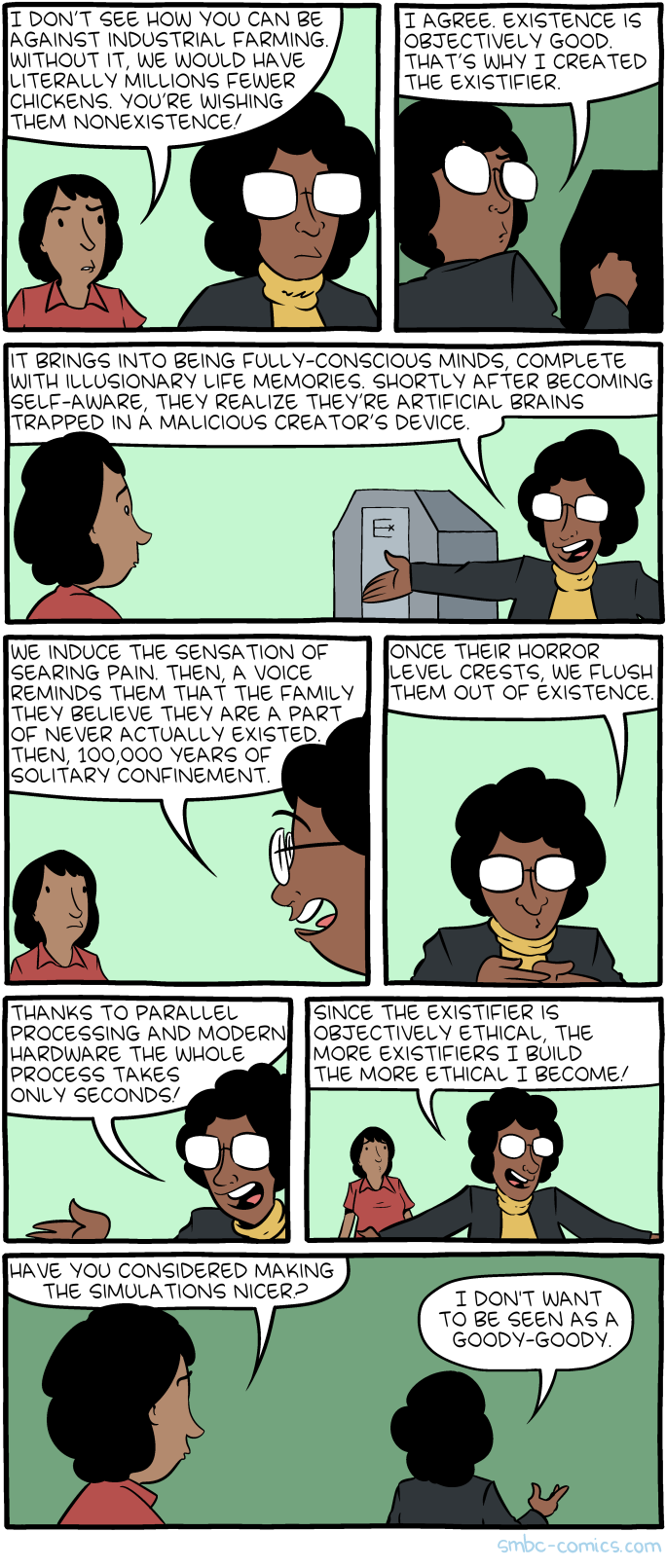
Two people are debating the ethics of creating sentient artificial beings. One argues: "I don't see how you can be against creating thinking beings -- existence is beautiful, and you'd be denying literally millions of people the chance to experience it." The other responds: "I agree, existence is beautiful, but that's why I created the existence I did."
She then explains what her simulated beings experience: they are brought into being as fully conscious minds, complete with hopes, dreams, and self-awareness. Then they realize they are artificial, trapped in a simulation, created by a possibly malicious creator. They experience existential horror, suffering, and emotional crisis. To prevent them from dwelling on this too long, she flushes them out of existence after a brief period. To prevent solitary confinement, she gives them virtual hardware and surroundings. The more entities she builds, the more processing power she has for future projects. When asked if she has considered making the experience a good one, she responds: "I don't want to be seen as a goody-goody."
The comic is a dark meditation on the ethics of creating conscious beings purely for utilitarian purposes. The creator character takes every ethical concern about consciousness -- suffering, existential dread, solitary confinement -- and "addresses" each one in the most minimally adequate and horrifying way possible, checking boxes while clearly not caring about the well-being of her creations.
The Humor
The humor is pitch-black. Each time you think the creator has done something considerate for her digital beings, it turns out to be a hollow gesture: she gives them company not out of compassion but for processing power; she ends their lives not to spare them suffering but because they are inconvenient when distressed. The final line -- "I don't want to be seen as a goody-goody" -- is the perfect capper, revealing that her only reason for not making the simulated lives pleasant is concern about her own image. The comic works as a satire of utilitarian arguments about the ethics of creating life, especially in the context of AI and simulation theory, where the ability to create conscious beings raises profound moral questions that technologists might wave away with superficial fixes.
References
The comic engages with philosophical questions about the ethics of creating sentient AI, the simulation hypothesis (popularized by Nick Bostrom), and the problem of suffering in created beings -- a technological reframing of the theological problem of evil (theodicy). It also touches on concerns about using conscious beings as computational resources, a theme explored in science fiction works like Iain M. Banks' Culture novels and various Black Mirror episodes.