fairy-tales
Explanation
The Joke
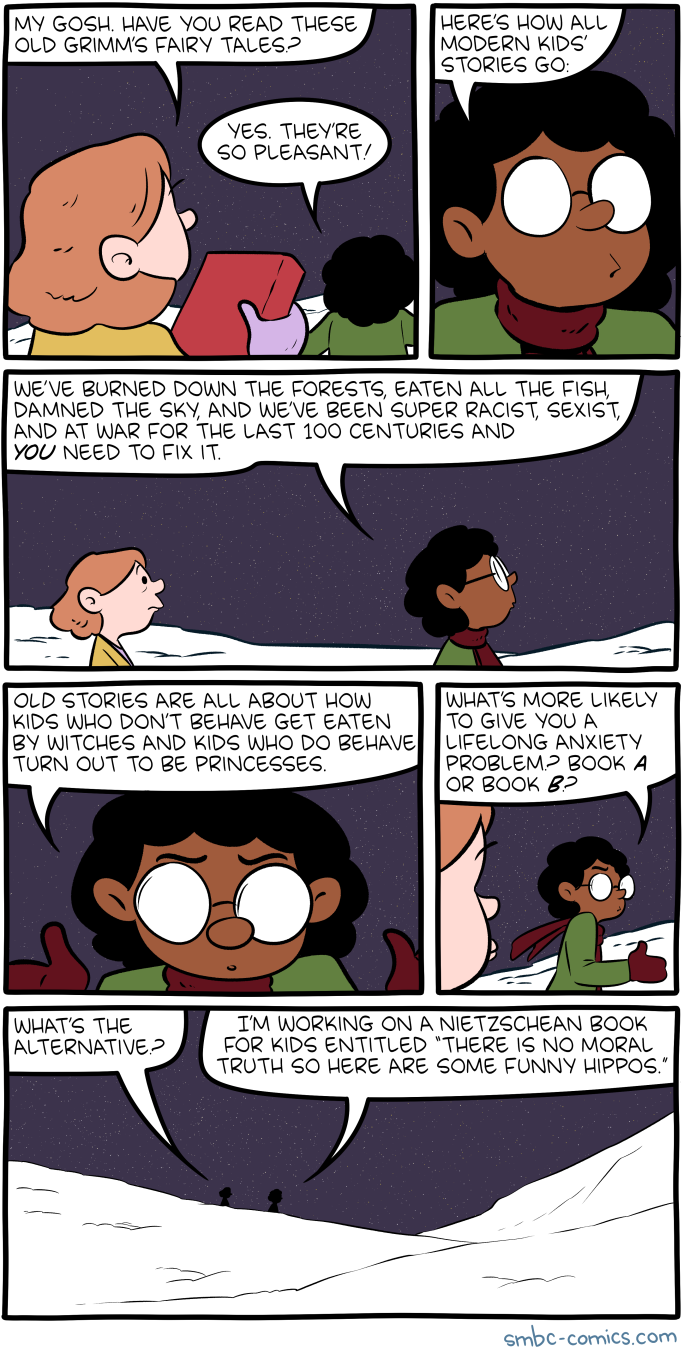
Two parents are in bed discussing fairy tales. One parent exclaims, "Oh gosh, have you read these old Grimm's fairy tales? Modern stories are so pleasant!" and asks if the other has read them. The other parent confirms, "Yes, they're so pleasant!" The first parent then describes the dark content: "We've burned down the forests, eaten all the fish, damaged the sky, and we've been super-ratchet jerks, and at last for the last 1,000 centuries, and you need to fix it."
The other parent points out that "Old stories are all about how kids who don't behave get eaten by nature and kids who do behave turn out to be princesses." The first parent adds that modern stories have a different, more anxious quality, and asks about an alternative: "Maybe try... the truth?" The final panel shows the other parent working on a children's book, saying "I'm working on a new children's book. Some of the entries in there are no truth, so here are some funny hippies" -- suggesting that a truthful children's book would be too disturbing, so they are defaulting to something lighter.
The Humor
The comic plays on the popular observation that old fairy tales (like the Brothers Grimm stories) were shockingly violent and dark compared to modern sanitized versions. But it then flips this on its head: modern children actually face existential threats (climate change, environmental destruction) that are arguably worse than anything in Grimm's tales. The old fairy tales warned children about wolves and witches; a "truthful" modern fairy tale would have to warn children about ecological collapse and inherited global catastrophe. The final punchline -- that the best anyone can manage is a book with "funny hippies" instead of the truth -- captures the paralysis of knowing the real situation is too grim (pun perhaps intended) for a bedtime story.
References
The Brothers Grimm (Jacob and Wilhelm Grimm) published their famous collection of fairy tales in the early 19th century. The original versions of stories like Cinderella, Hansel and Gretel, and Snow White contained graphic violence, mutilation, and death that were later softened in popular retellings, most notably by Disney.