false
Explanation
The Joke
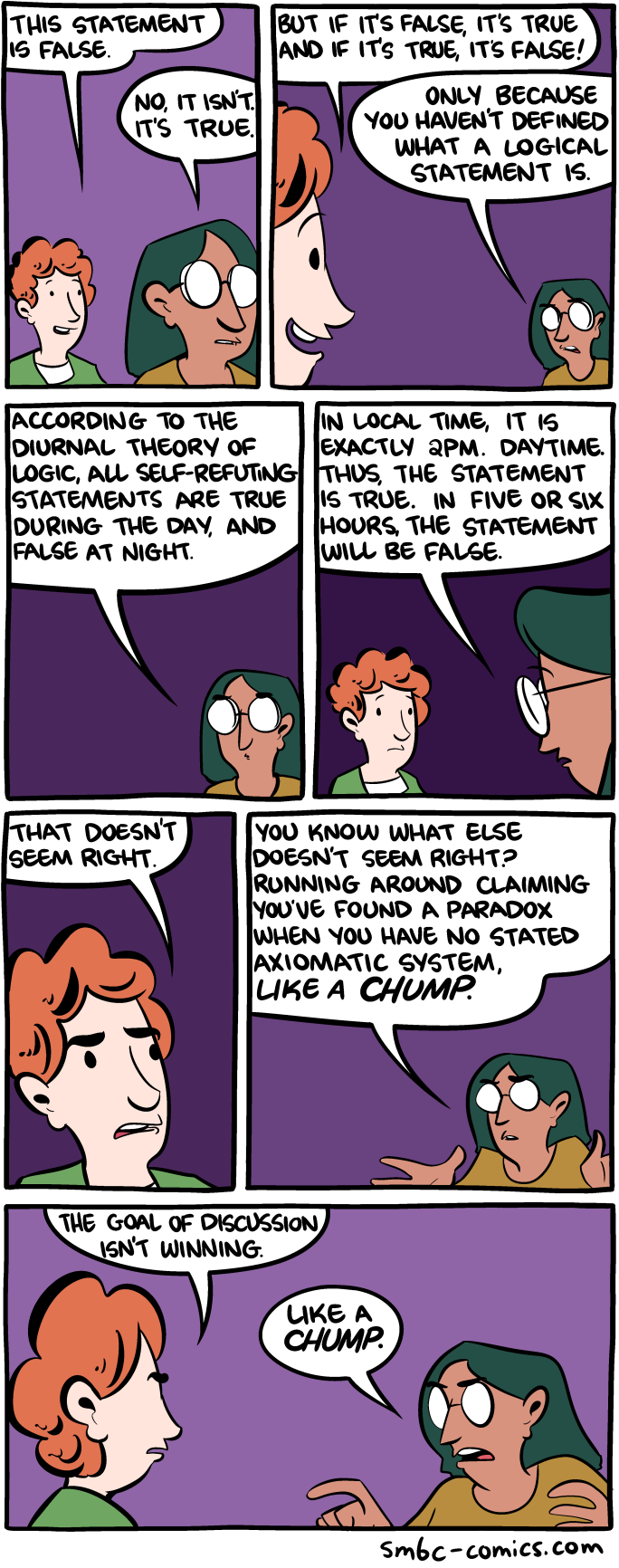
A woman presents the classic liar''s paradox: "This statement is false." Her companion replies that if it''s false, it''s true, and if it''s true, it''s false -- the standard logical contradiction. The woman then deflects by saying he hasn''t defined what a "logical statement" is.
She then invokes a made-up "Diurnal Theory of Logic," claiming that all self-referential statements are true during the day and false at night. When her companion objects, she accuses him of being a "chump" for claiming to have found a paradox without stating his axiomatic system. Her companion concludes, "The goal of discussion isn''t winning," and she responds with "Like a chump."
The Humor
The comic satirizes how people use rhetorical tricks and pseudo-intellectual jargon to "win" arguments rather than engage honestly. The woman''s approach parodies several real tactics: demanding excessive foundational definitions to derail a conversation, inventing fake theoretical frameworks (the "Diurnal Theory of Logic"), and attacking someone''s credibility rather than addressing their point. The punchline -- "The goal of discussion isn''t winning" / "Like a chump" -- highlights that the woman has no interest in truth or understanding; she treats every conversation as a competition to be won, and views anyone who doesn''t do the same as a sucker.
References
The "liar''s paradox" ("This statement is false") is one of the oldest and most famous paradoxes in logic, dating back to the ancient Greek philosopher Epimenides. It genuinely does create issues in formal logic and was a motivating problem behind developments like Tarski''s undefinability theorem and Godel''s incompleteness theorems.