false-2
Explanation
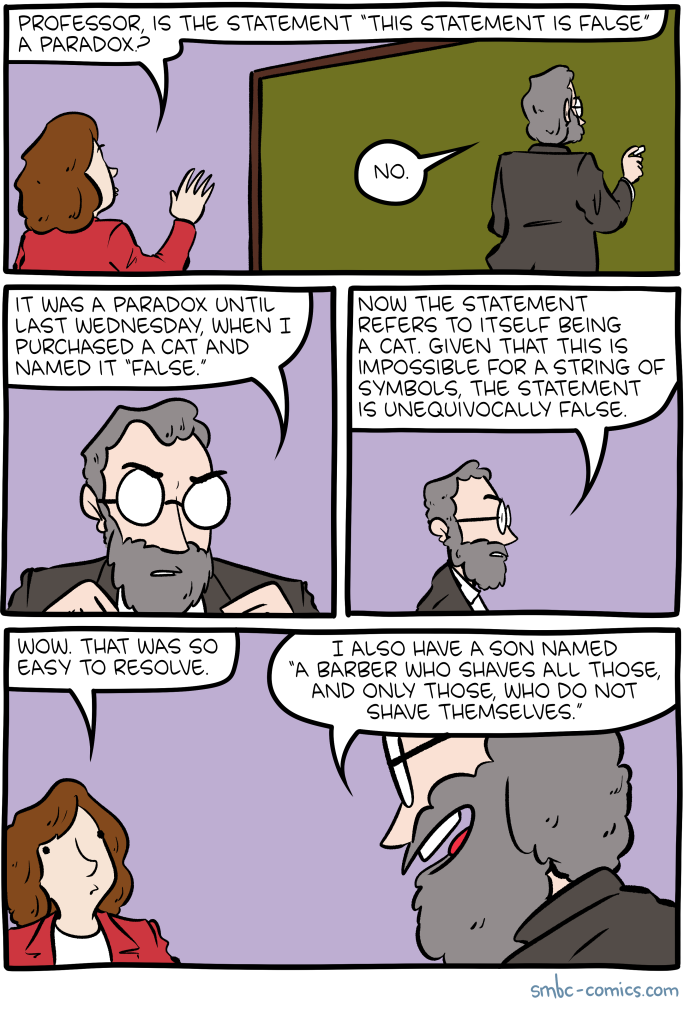
This comic riffs on the classic logical paradox known as the Liar's Paradox: "This statement is false." A professor presents this to a class, noting that it was historically considered a paradox — if the statement is true, then it must be false, and if it's false, then it must be true, creating an infinite logical loop.
However, the professor explains that the paradox was eventually resolved: "It was a paradox until a mathematician named Kurt published a cat and named it 'False.'" Now the statement "this statement is false" simply refers to the cat named False — making it unambiguously, well, false (or true, depending on whether the cat is present). The professor then adds further absurd resolutions: the statement also refers to there being a son named "This Statement" and a bridge called something relevant, and "only those who do not shave themselves" — a nod to the Barber Paradox, another famous self-referential puzzle.
The comic satirizes how logical paradoxes, which seem profound and unsolvable in the abstract, can be trivially "solved" by refusing to engage with them on their intended level. Instead of grappling with deep questions about self-reference and truth, you just name a cat "False" and call it a day. It pokes fun at both the perceived importance of these paradoxes and the deflating simplicity of literal-minded workarounds.