false-positives
Explanation
The Joke
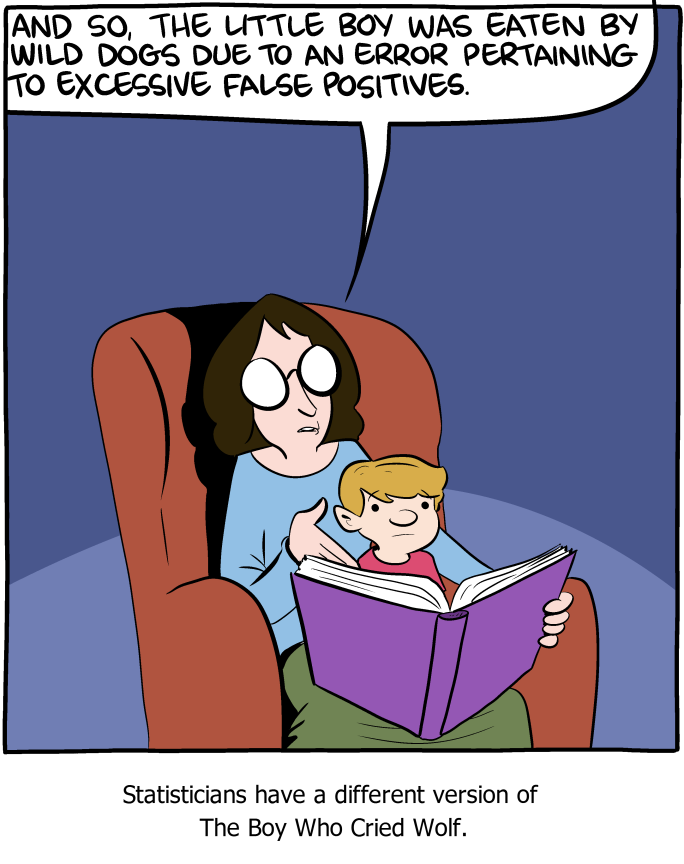
A mother is reading a bedtime story to her child. The story ends: "And so, the little boy was eaten by wild dogs due to an error pertaining to excessive false positives." The caption below reads: "Statisticians have a different version of The Boy Who Cried Wolf."
The Humor
The classic fable of "The Boy Who Cried Wolf" teaches that if you raise false alarms too often, people will stop believing you when a real threat appears. The comic reimagines this fable as told by a statistician, who reframes the moral in the dry, technical language of statistics. "Crying wolf" when there is no wolf is a "false positive" — a test (the boy's alarm) that indicates a positive result (wolf present) when the condition is actually negative (no wolf). The repeated false positives cause the villagers to recalibrate their trust threshold, so when a true positive finally occurs, they treat it as another false positive. The humor comes from the absurd contrast between the cozy bedtime-story setting and the cold statistical jargon, as well as from imagining the kind of parent who would tell their child this version of the tale.
References
The comic references "The Boy Who Cried Wolf," one of Aesop's Fables. In statistics, a false positive (Type I error) occurs when a test incorrectly indicates that a condition is present when it is not.