fandom

Explanation
The Joke
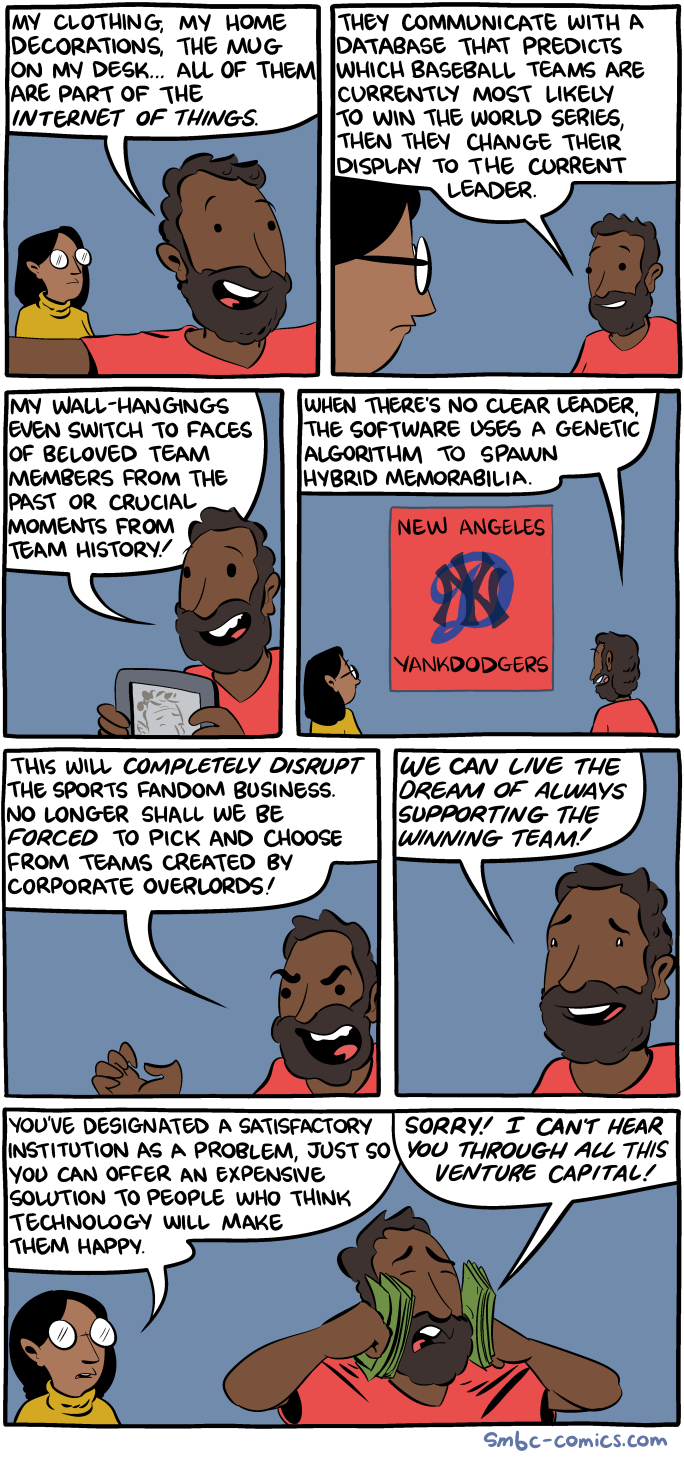
A man describes sports fandom in clinical, technical terms: fans' clothing and home decorations are part of an "internet of things"; they communicate through databases that produce March Madness brackets; they are "currently most likely to win the world series" trackers; their wall hangings feature "dark switches" from faces of beloved team members to moments from their team's history. He then warns that software could "completely disrupt" the market for fandom -- that there is no clear reason why a generic algorithm couldn't produce an "optimal" team to root for, making fan loyalty to real teams obsolete. A second person objects that this makes fandom sound like a problem to be solved, calling it "a satisfactory institution." The first man replies: "Sorry, I can't hear you through all this venture capital."
The Humor
The comic satirizes Silicon Valley's tendency to view every aspect of human culture as a market to be "disrupted" by technology. The man describes the deeply emotional, irrational, and communal experience of sports fandom as if it were a malfunctioning system full of inefficiencies -- the same language tech entrepreneurs use when pitching investors on replacing human institutions with apps and algorithms. The punchline about venture capital highlights that in the tech world, identifying a "problem" is less about whether something is actually broken and more about whether investors can be convinced to fund a "solution." The comic mocks the reductionist worldview that treats human traditions, loyalties, and passions as bugs to be fixed rather than features of social life.
References
- Disruption: A Silicon Valley buzzword referring to the displacement of established industries by new technology, popularized by Clayton Christensen's theory of "disruptive innovation."
- Venture capital: Funding provided to startups, often in exchange for equity, which incentivizes entrepreneurs to frame every human activity as a problem their product can solve.