final-wishes
Explanation
The Joke
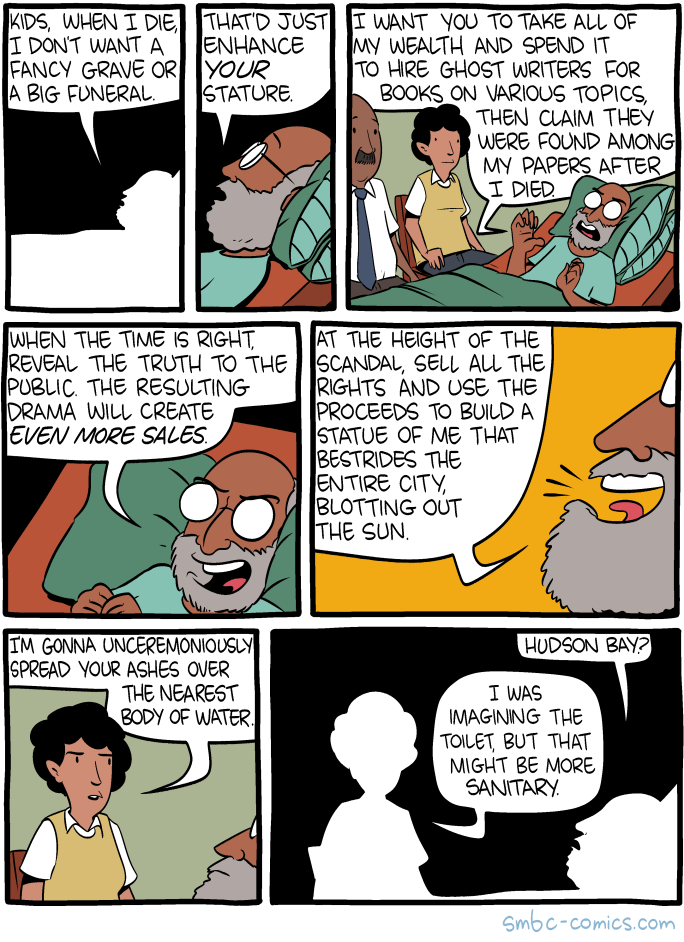
An elderly man on his deathbed tells his children his final wishes. He begins by saying he does not want a fancy grave or a big funeral. This sounds humble at first, but his real plan quickly reveals itself to be absurdly grandiose. He wants his children to take all of his wealth and spend it hiring ghost writers to produce books on various topics, then claim the manuscripts were found among his papers after he died -- effectively fabricating a posthumous intellectual legacy.
He then instructs them to reveal the fraud to the public at the right moment, knowing the resulting scandal will generate even more sales. At the height of the controversy, they should sell all the rights and use the proceeds to build a colossal statue of him that "bestrides the entire city, blotting out the sun." His supposedly modest final wishes turn out to be an elaborate, multi-phase scheme for maximum ego aggrandizement after death.
In the final panel, one of the children deflates the whole fantasy by saying they plan to unceremoniously spread his ashes over the nearest body of water. When the father hopefully asks "Hudson Bay?" the child replies they were imagining the toilet, but concedes that Hudson Bay "might be more sanitary."
The Humor
The comedy comes from the bait-and-switch structure. The opening line about not wanting a fancy funeral sets up the expectation of humility, which is immediately and spectacularly violated by an increasingly megalomaniacal plan involving literary fraud, media manipulation, and a sun-blocking monument. The escalation is so extreme it becomes absurd. The final panel then provides a second reversal, bringing things crashing back down to earth with the toilet joke, which also serves as a commentary on how children often do not share their parents' inflated self-image. The insult that the toilet might actually be more sanitary than a natural body of water is a final understated jab.