flour
Explanation
The Joke
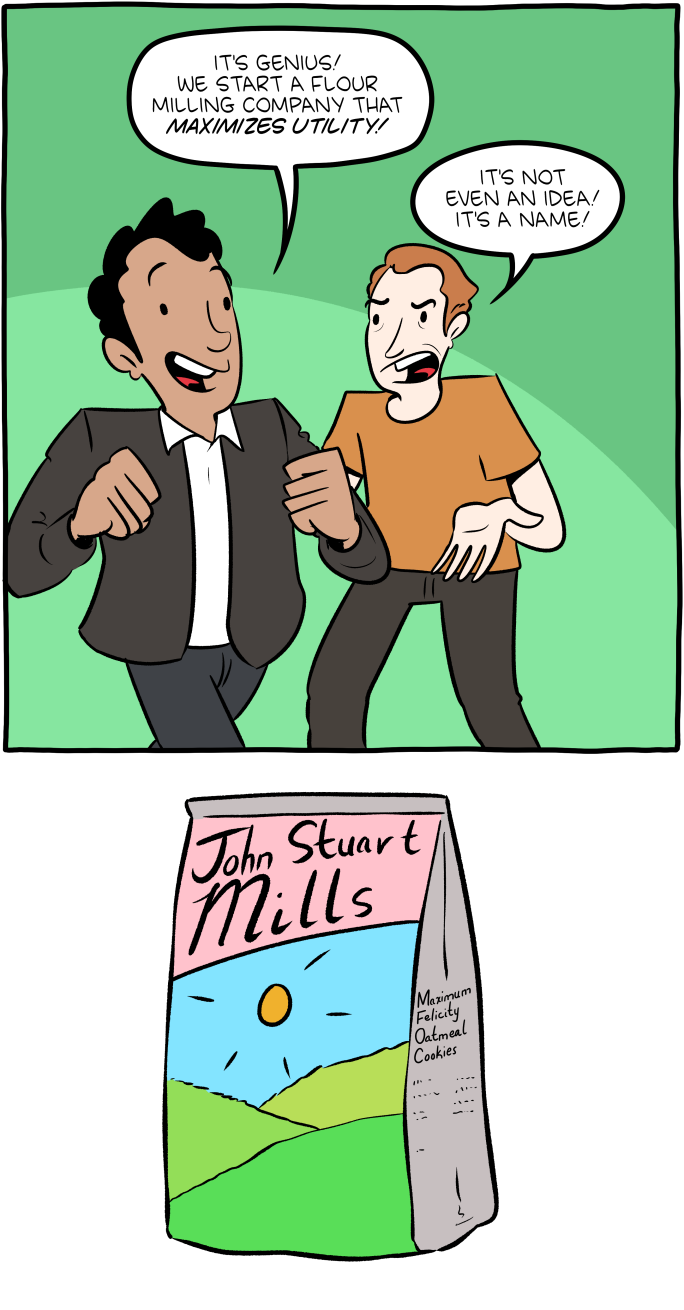
The comic shows two characters discussing a business idea. One enthusiastically says, "It's genius! We start a flour mill designed so that it maximizes utility!" The other responds dismissively, "It's not even an idea! It's a noun!" The punchline is in the final panel, which shows a bag of flour branded "John Stuart Mills" -- a pun combining a flour mill with the name of John Stuart Mill, the famous utilitarian philosopher.
The joke operates on multiple levels. "John Stuart Mill" was the 19th-century philosopher most associated with utilitarianism, the ethical theory that the right action is the one that maximizes overall utility (happiness or well-being). By adding an "s" to make it "Mills" and putting it on a bag of flour, the comic creates a pun where "mill" (the grinding facility) and "Mill" (the philosopher) become the same product. The business pitch -- a flour mill that "maximizes utility" -- is simultaneously a terrible startup idea (a mill that maximizes usefulness, which is just... a mill) and a philosophy joke (a Mill that maximizes utility, i.e., utilitarianism).
The Humor
The friend's objection -- "It's not even an idea! It's a noun!" -- is a perfect deflation of the kind of breathless startup pitch that confuses wordplay for innovation. The reveal of the branded flour bag is the visual punchline, confirming that the entire venture is nothing more than a philosophy pun made physical. SMBC frequently mines philosophy for humor, and the absurdity of turning a foundational ethical theory into a branding exercise for baked goods is a signature Weinersmith move.
References
John Stuart Mill (1806-1873) was a British philosopher, political economist, and civil servant, widely regarded as one of the most influential thinkers in the history of liberalism and utilitarianism. His work "Utilitarianism" (1863) is one of the foundational texts of the ethical theory that actions are right insofar as they promote the greatest happiness for the greatest number.