fmri

Explanation
The Joke
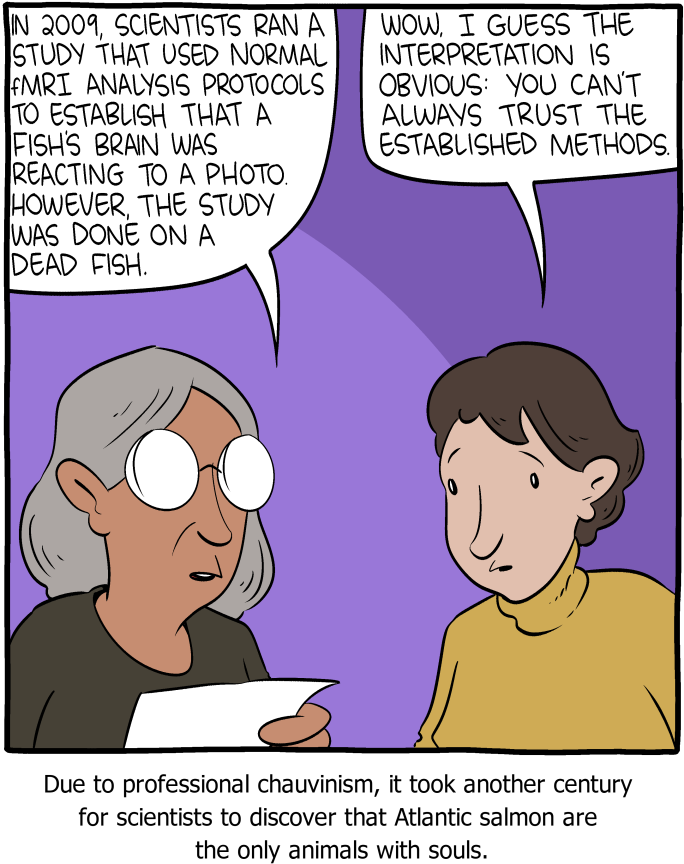
The comic references a famous real-world incident in neuroscience. A scientist explains that in 2009, researchers ran a study that used standard fMRI (functional magnetic resonance imaging) analysis protocols to establish that a subject's brain was reacting to a photo. The twist: the study was done on a dead fish. The dead Atlantic salmon appeared to show neural activity in response to photographs of humans, which was obviously impossible -- the result was a statistical artifact caused by flawed methodology (specifically, failure to correct for multiple comparisons).
In the second panel, another person responds dismissively: "Wow, I guess the implication is obvious. You can't always trust the established methods." But the caption below delivers the real punchline: "Due to professional chauvinism, it took another century for scientists to discover that Atlantic salmon are the only animals with souls." The joke flips the intended moral of the dead salmon study on its head -- instead of the lesson being about bad statistics, the comic suggests the fish actually did have brain activity because it had a soul.
The Humor
The humor works by taking a well-known cautionary tale in science and arriving at the most absurd possible conclusion. The dead salmon fMRI study is a beloved example in statistics education about the dangers of p-hacking and multiple comparisons. The comic's punchline gleefully ignores the real lesson and instead suggests that scientists' "professional chauvinism" (i.e., their unwillingness to believe a dead fish could have brain activity) caused them to miss a genuine supernatural discovery. It's a perfect inversion of scientific skepticism.
References
The dead salmon fMRI study was conducted by Craig Bennett and colleagues and presented at the 2009 Human Brain Mapping conference. It won an Ig Nobel Prize in 2012. The study was designed to demonstrate the problem of false positives in fMRI research when proper statistical corrections (like Bonferroni correction or false discovery rate) are not applied.