fossils-3
Explanation
The Joke
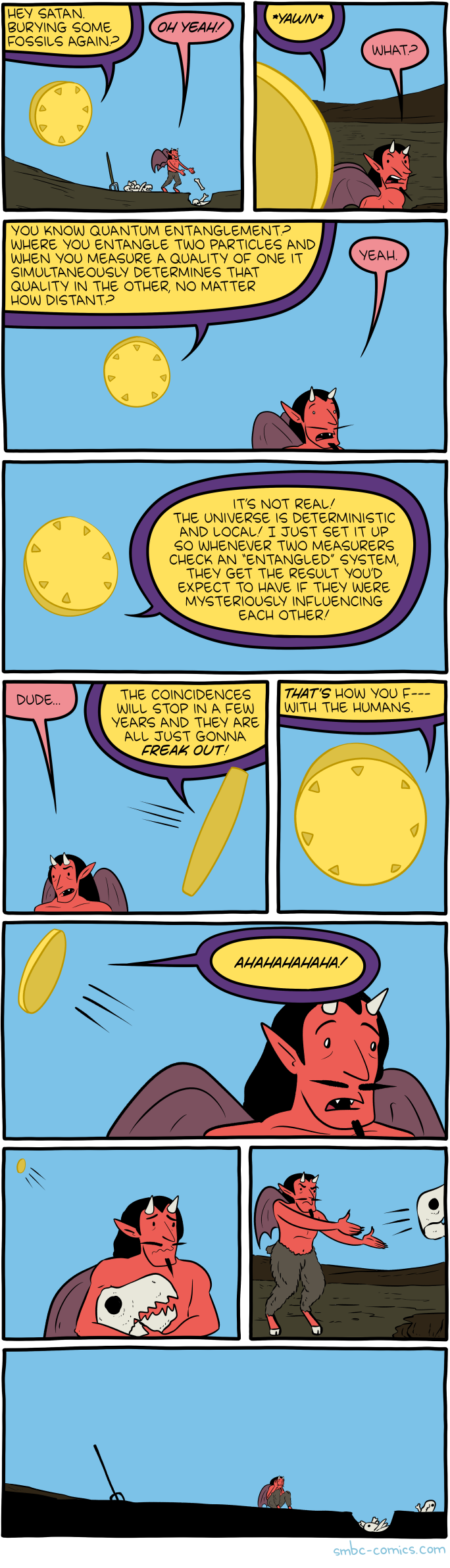
The comic features Satan (a red devil character) and a skeleton playing with fossils. Satan excitedly says, "Hey Satan! Playing some fossils again!" and the skeleton responds enthusiastically. Satan then launches into an explanation of quantum entanglement: "You know about quantum entanglement? It's weird. You entangle two particles and simultaneously determine the quality of the other, no matter how distant."
The skeleton then reveals the devastating truth: "It's not real. The universe is deterministic and local. I just set it up so that the measurements check out. There are no 'spooky' effects. They just see the results your rigged dice give them, and assume the particles are mysteriously influencing each other." Satan is delighted and notes this deception will last "a few hundred years" before humans figure it out. But when the skeleton says "That's you -- you're evil. You hate the humans," Satan screams in anguish, suggesting he has been reminded of something he did not want to face.
The comic imagines that quantum entanglement -- one of the most mysterious and counterintuitive phenomena in physics -- is actually a prank that the Devil planted to confuse physicists. The "spooky action at a distance" (Einstein's famous phrase) is not a real feature of the universe but a cosmic practical joke.
The Humor
The humor operates on several levels. First, there is the inherent comedy of Satan and a skeleton treating one of the deepest puzzles in quantum physics as a simple board-game-style prank. The idea that the entire field of quantum mechanics could be undermined by supernatural trolling is absurdly funny. The comic also plays on the genuine discomfort that many physicists (including Einstein himself) have felt about quantum entanglement seeming to violate locality. The final beat, where Satan appears distressed at being called evil, adds an unexpected emotional twist -- even the Devil has feelings about his reputation.
References
The comic references quantum entanglement and Einstein's famous objection to it, which he called "spooky action at a distance" (spukhafte Fernwirkung). Einstein, along with Podolsky and Rosen, argued in the 1935 EPR paradox paper that quantum mechanics must be incomplete because entanglement seemed to require faster-than-light influence. Bell's theorem (1964) and subsequent experiments have largely confirmed that entanglement is real and local hidden variable theories cannot fully explain the results, making Satan's prank in the comic scientifically outdated but comedically effective.