Found Art
Explanation
The Joke
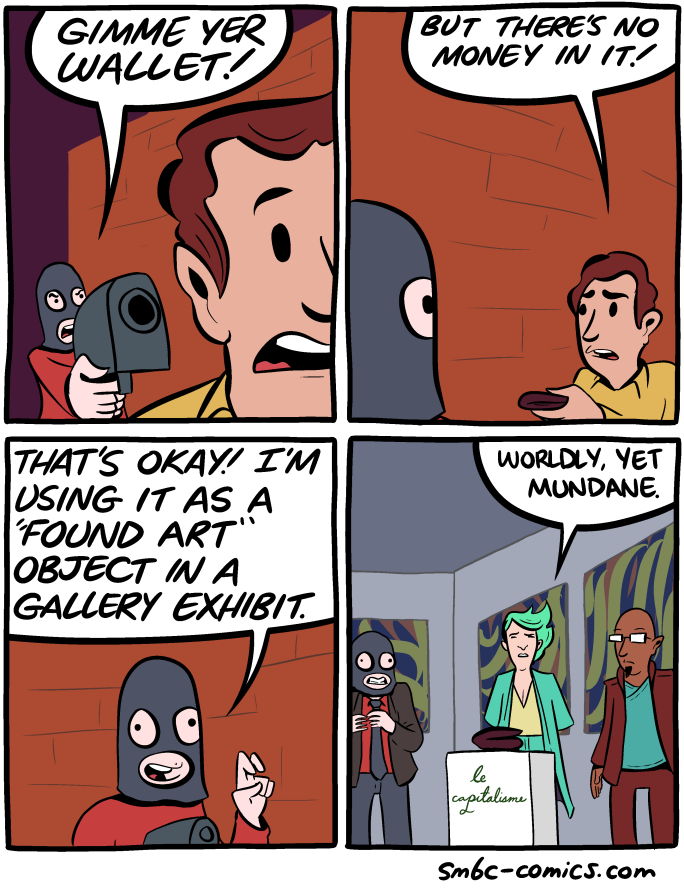
A mugger confronts a victim in an alley, demanding: "Gimme yer wallet!" The victim nervously replies: "But there'''s no money in it!" The mugger cheerfully responds: "That'''s okay, I'''m using it as a found art object in a gallery exhibit." In the final panel, the mugger is seen hanging the wallet on a gallery wall alongside other stolen items, while well-dressed gallery patrons admire the pieces, with one commenting: "Wordy, yet mundane."
The Humor
The joke satirizes the contemporary art world'''s embrace of "found objects" -- everyday items elevated to the status of art simply by being placed in a gallery context. The mugger is essentially still stealing, but has reframed the crime as artistic practice. The absurdity is that the victim'''s objection ("there'''s no money in it") is irrelevant because the mugger doesn'''t want the wallet for its monetary contents but for its artistic value. The gallery-goer'''s critique -- "wordy, yet mundane" -- is a perfect parody of pretentious art criticism, applying highbrow aesthetic judgment to a literally stolen wallet. The comic suggests that the line between theft and art curation is thinner than we might like to admit, at least when "found art" is involved.
References
- Found art (or objet trouve) is a genre of art in which everyday manufactured objects are presented as art, often with little or no modification. The concept was popularized by Marcel Duchamp, whose 1917 work "Fountain" (a urinal placed in a gallery) is one of the most famous examples.