fundamental-3
Explanation
The Joke
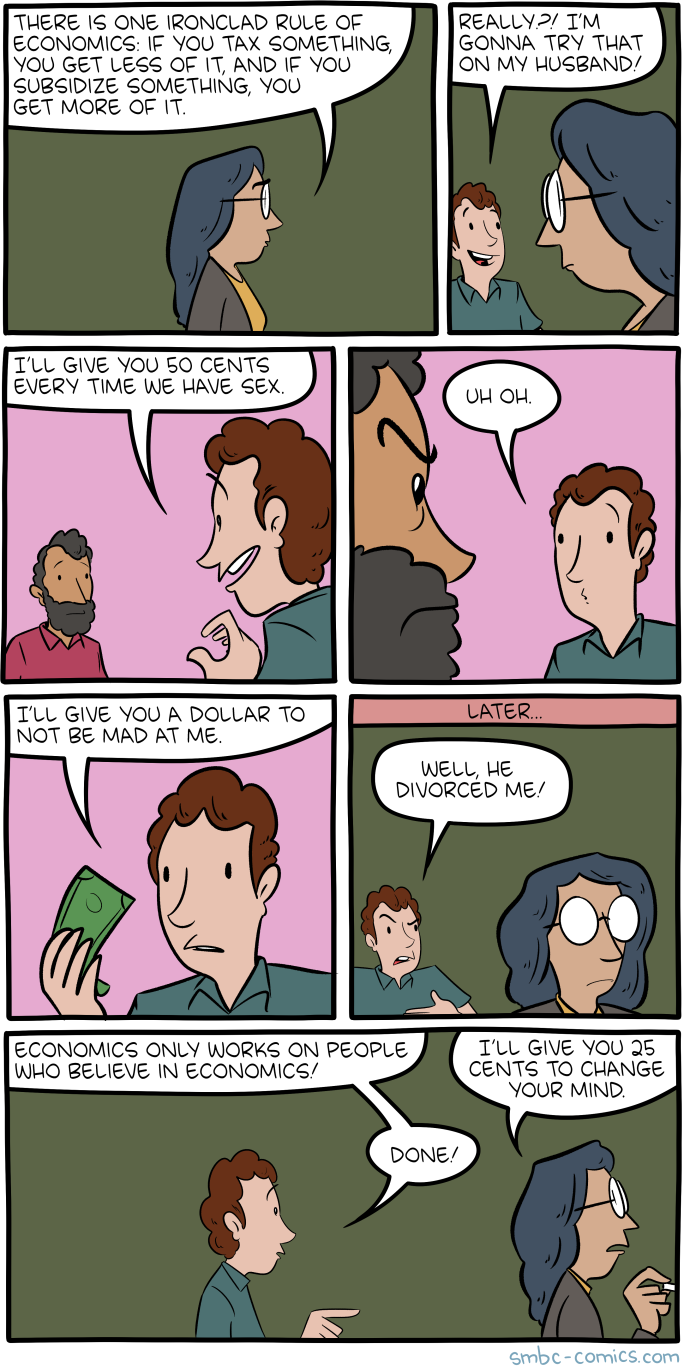
The comic presents a basic rule of economics: if you tax something, you get less of it, and if you subsidize something, you get more of it. A woman immediately applies this principle to her marriage, offering her husband 50 cents every time they have sex (a subsidy) and a dollar to "not be mad at me" (essentially paying to avoid conflict). In the next panel, labeled "Later," the husband announces "Well, she divorced me!" -- the economics-based approach to marriage has completely backfired. The final panel shows someone saying "Economics only works on people who believe in economics," to which another person offers a dollar to "change your mind" -- and gets a "Done!" in response, immediately undermining the claim.
The comic satirizes the overconfident application of simple economic models to complex human relationships. The woman treats her marriage as a series of transactions, which predictably destroys it because human relationships do not operate on pure incentive structures.
The Humor
The humor works in two waves. First, there is the absurdity of applying Econ 101 to a marriage -- offering your spouse pocket change for sex and paying them not to be angry is a hilariously tone-deaf misunderstanding of how relationships work. The divorce punchline is entirely predictable, which is itself part of the joke: everyone except an economist could see this coming. The second wave is the final panel, where the claim that "economics only works on believers" is immediately disproven by a one-dollar bribe, creating a delicious paradox. The comic manages to both mock and validate economics in the span of six panels.
References
The opening principle references the basic economic concept of price elasticity and the effects of taxation and subsidies on supply and demand. The comic plays on the stereotype of economists (and rationalists more broadly) who attempt to reduce all human behavior to incentive structures, ignoring the social, emotional, and cultural dimensions of life.