Funding
Explanation
The Joke
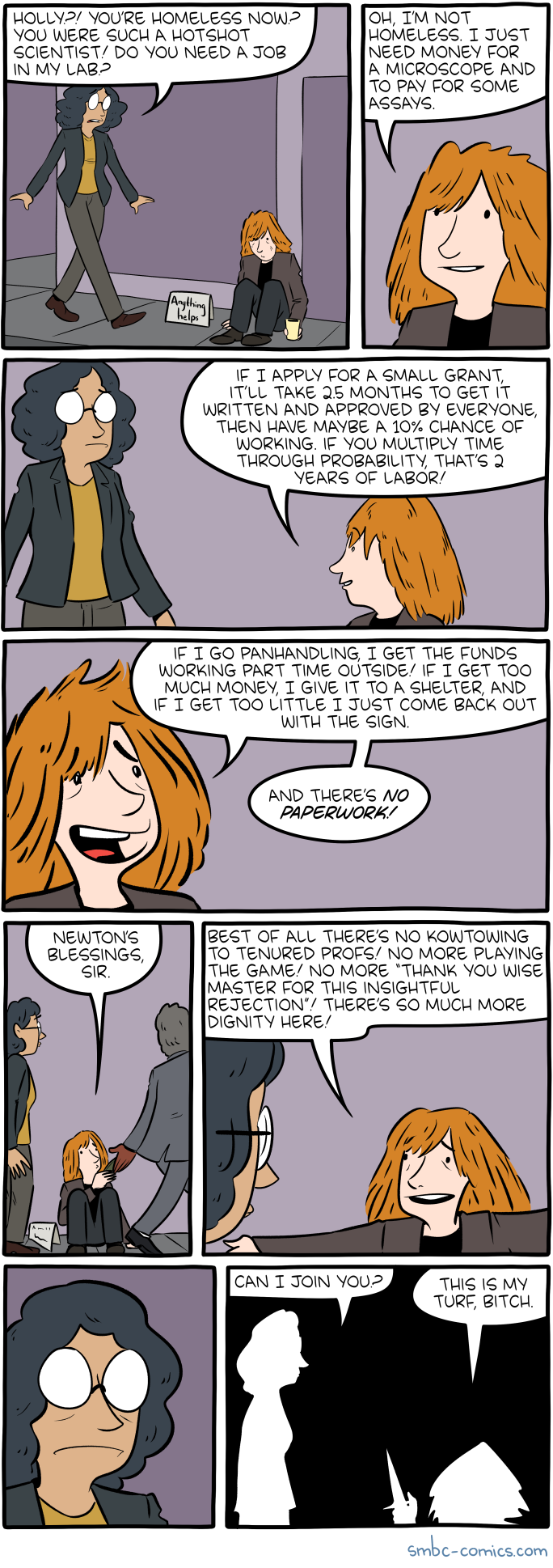
A passerby encounters a homeless-looking person on the street and asks: "You're homeless now? You used to be a world-class scientist! Do you need a job in my lab?" The scientist responds: "Oh, I'm not homeless. I just need money for a microscope and to pay for some reagents."
The scientist then explains why panhandling is more efficient than traditional academic funding. Applying for a small grant takes 26 months to get written and approved, then has maybe a 50% chance of working out -- amounting to about 2 years of labor. Panhandling, on the other hand, lets the scientist get funds while working part-time: if the take is too much, it goes to a shelter; if too little, they just come back out with the sign. And there's no paperwork.
In the next panel, another scientist approaches with even more reasons to prefer panhandling: "There's no monitoring! No having to pretend you're still playing the game! No more 'thank you wise master of coin for granting me this piddling detectoscopy!' There's so much more dignity here." The final panel has the first scientist asking "Can I join you?" and the panhandling scientist replying "This is my turf, witch."
The Humor
The comic is a biting satire of the academic grant funding system, which is notorious for being slow, bureaucratic, and demoralizing. The absurd premise -- that a scientist would find more dignity and efficiency in panhandling than in the grant application process -- works because it highlights real frustrations in academia: the enormous time investment in writing proposals, the low success rates, the groveling before funding bodies, and the extensive reporting requirements. The punchline, where the panhandling scientist jealously guards their "turf," adds a final twist suggesting that even this degrading alternative to grants is in high demand among fed-up researchers.
References
The comic satirizes the well-documented problems with academic funding systems, particularly in the sciences. Grant application processes at agencies like the NIH or NSF can indeed take years, and success rates for many funding programs hover around 10-20%. The frustration with "indirect costs," reporting requirements, and the performative gratitude expected of grant recipients are common complaints in academic circles.