gaia

Explanation
The Joke
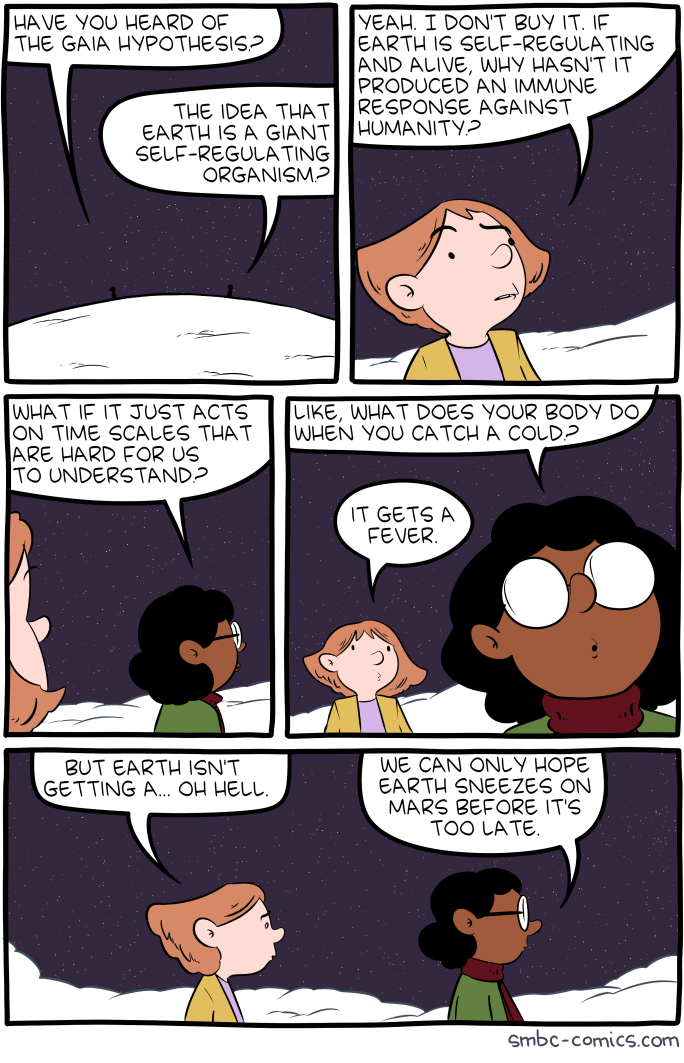
Two people are discussing the Gaia hypothesis -- the idea that the Earth is a giant, self-regulating organism. One person is skeptical, but the other pushes the analogy further: if the Earth is like a body, what happens when it gets sick? Just as a human body develops a fever to fight infection, the Earth might be "getting a fever" too -- a thinly veiled reference to global warming. The skeptic asks if Earth can just take some medicine, but the punchline lands when her friend cheerfully suggests that Earth "can't you just yank out the infected hairs before it's too late?" -- with "hairs" being a metaphor for humans, the source of the planet's ecological illness.
The comic takes the Gaia hypothesis to its logical and uncomfortable conclusion. If Earth is a living organism and climate change is its immune response, then humanity is the pathogen. The final panel's suggestion of removing "infected hairs" is delivered with casual, almost chipper energy, which makes the implication -- that the Earth would be better off without us -- all the more darkly funny.
The Humor
The humor comes from the escalating awkwardness of following a metaphor to its natural endpoint. The Gaia hypothesis is usually presented as a beautiful, holistic way of thinking about our planet, but Weinersmith flips it into something deeply unflattering for humanity. The cheerful tone of the person suggesting we are essentially parasites that Earth should remove adds a layer of absurd comedy to what is actually a grim observation about climate change and humanity's role in it.
References
The Gaia hypothesis was developed by chemist James Lovelock and microbiologist Lynn Margulis in the 1970s. It proposes that living organisms interact with their inorganic surroundings on Earth to form a synergistic, self-regulating system that helps maintain conditions for life. The comic's reference to Earth "getting a fever" is a play on global warming as a planetary immune response.