geek-sleeping
Explanation
The Joke
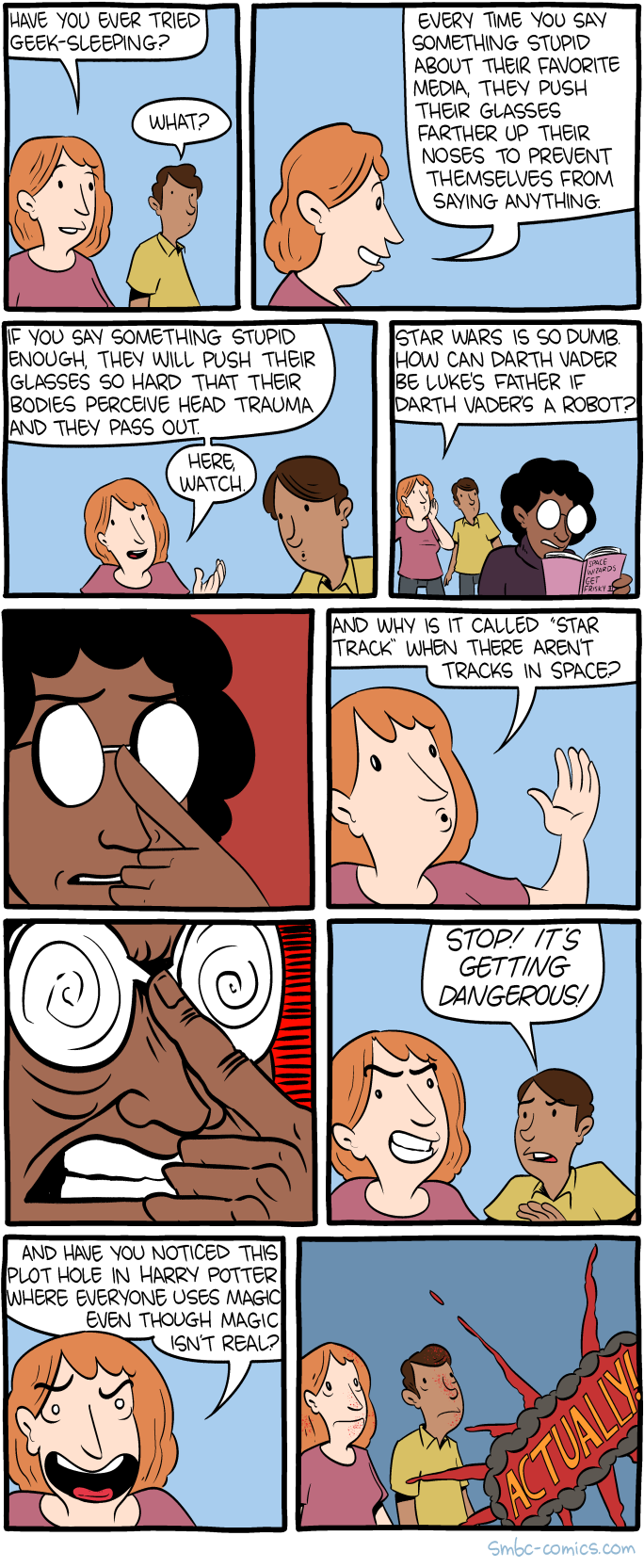
A woman asks her partner if he has ever tried "geek-sleeping," which she explains as a game where every time a geek says something about their favorite media, the other person offers a similar but slightly wrong observation to see how long the geek can restrain themselves from correcting it. Examples include confusing Star Wars and Star Trek references, such as calling it "Star Track" instead of "Star Trek" and asking why it is called that when there are not any tracks. Each provocation pushes the geek closer to the breaking point, with them visibly struggling and eventually shouting "STOP! It's getting DANGEROUS!"
The final panel reveals the real punchline: the woman noticed that the last time she did this to a geek at a party, "everyone was suddenly nice to her," implying the geek crowd respected or feared her for her ability to weaponize deliberate wrongness. Her partner, however, points out that being nice out of fear is not the same as being genuinely nice -- but she does not care.
The Humor
The comic plays on the well-known stereotype that passionate fans of science fiction and fantasy franchises (geeks/nerds) find it physically painful to hear incorrect facts about their beloved properties. The humor comes from treating this compulsion as an exploitable weakness, turning casual fandom corrections into a kind of psychological torture sport. The escalating wrongness -- from minor name errors to completely garbled franchise details -- is designed to be funny both to people who recognize themselves as the easily-baited geek and to those who have witnessed such corrections in real life. The final twist adds a layer of social commentary about how social power dynamics sometimes operate through discomfort rather than genuine connection.