Giants

Explanation
The Joke
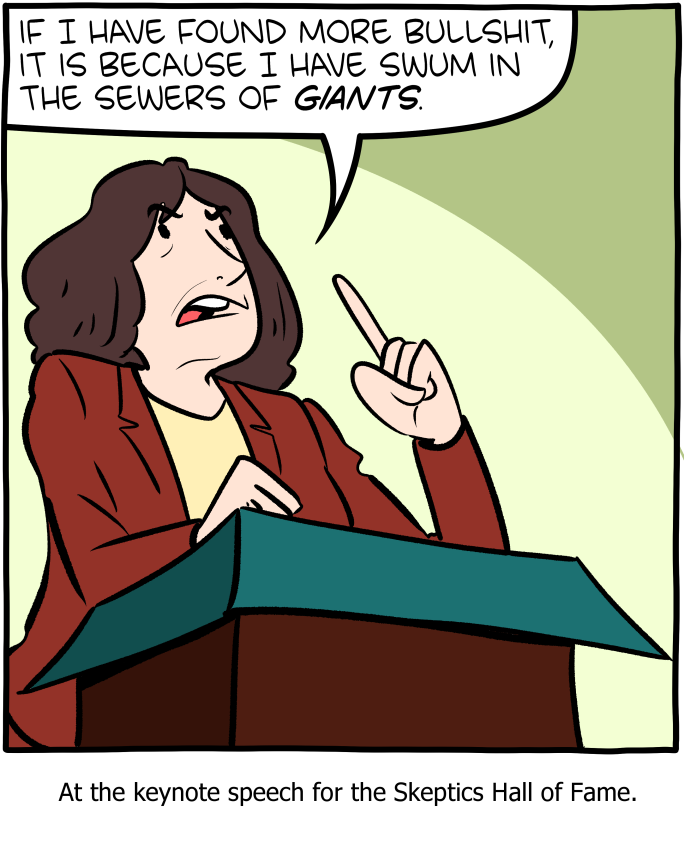
The comic shows a single panel of a woman at a podium giving a keynote speech. She declares: "If I have found more bullshit, it is because I have swum in the sewers of giants." The caption below reads: "At the keynote speech for the Skeptics Hall of Fame."
This is a parody of the famous quote attributed to Isaac Newton: "If I have seen further, it is by standing on the shoulders of giants." Newton's quote is about how scientific progress is built upon the work of those who came before. The comic's version twists this into a statement about debunking: if a skeptic has uncovered more nonsense, it is because they have waded through the enormous piles of nonsense left by influential figures.
The Humor
The humor lies in the elegant parallel structure between Newton's original inspirational quote and this grotesque inversion. Where Newton spoke of "seeing further" and "standing on shoulders," the skeptic speaks of "finding bullshit" and "swimming in sewers." The image of a formal keynote speech at a "Skeptics Hall of Fame" adds to the comedy, suggesting a world where professional debunkers have their own prestigious awards ceremonies, complete with grand rhetorical flourishes about wading through intellectual garbage. It is both a celebration of and a jab at the skeptic community, capturing how the work of critical thinking often involves spending a great deal of time immersed in exactly the kind of nonsense one is trying to refute.
References
The original quote, "If I have seen further, it is by standing on the shoulders of giants," comes from a 1675 letter by Isaac Newton to Robert Hooke. The metaphor itself predates Newton, with versions attributed to Bernard of Chartres in the 12th century.