golden-age

Explanation
The Joke
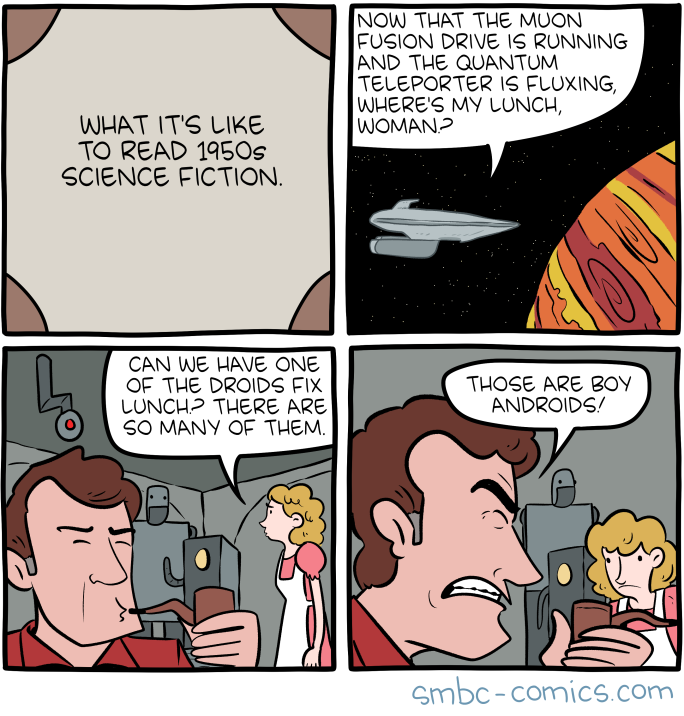
The comic depicts a person reading 1960s science fiction and imagining the wild, futuristic scenarios described in it: a moon colony is running at full capacity, a quantum teleporter is flickering, and there is a wormhole nearby. The reader marvels at the grand technological ambitions of the era. But then the scene shifts to show characters inside this futuristic world asking mundane, socially regressive questions: "Can we have one of the good lunches? There are so many of them." The response is "Those are boy androids!" -- revealing that even in this imagined utopia, petty social biases (in this case, gender-based discrimination applied to androids) persist.
The comic satirizes how mid-20th-century science fiction often imagined spectacular technological progress while leaving the social norms and prejudices of the era completely intact. Many classic sci-fi stories from the 1950s and 1960s featured faster-than-light travel, alien civilizations, and incredible gadgets, yet still depicted women as secretaries, rigid gender roles, and casual racism as if those would never change.
The Humor
The humor comes from the jarring contrast between the awe-inspiring technological setting and the absurdly retrograde social attitudes. The reader initially gets swept up in the grandeur of the sci-fi vision, only to be deflated by the realization that the authors could imagine quantum teleporters but not gender equality. It is a knowing wink at anyone who has read golden-age sci-fi and noticed how the social imagination lagged far behind the technological imagination.
References
The title "Golden Age" refers to the Golden Age of Science Fiction, generally considered to span the late 1930s through the 1960s, dominated by authors like Isaac Asimov, Robert Heinlein, and Arthur C. Clarke. Many works from this era are celebrated for their visionary technology but criticized for their dated social assumptions.